


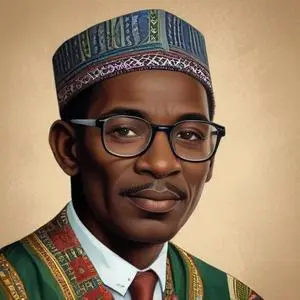
A pioneering scholar who merged anthropology, history, and physics to reclaim and redefine African cultural heritage and identity, challenging prevailing Eurocentric narratives.
Cheikh Anta Diop, a Senegalese historian, anthropologist, physicist, and politician, is renowned for his groundbreaking work on the origins of human races and precolonial African culture. His research and theories have been instrumental in shaping the concept of Afrocentricity, challenging traditional Eurocentric views on African history and culture.
Born on December 29, 1923, in Thieytou, Diourbel Region, Senegal, Diop hailed from an aristocratic Muslim Wolof family. He was educated in a traditional Islamic school, where he developed a strong foundation in Arabic, Islamic studies, and classical Wolof.
Diop's family was part of the Mouride brotherhood, a unique and independent Muslim fraternity in Africa. He obtained the colonial equivalent of the metropolitan French baccalaureate in Senegal before moving to Paris to pursue higher education.
In 1946, at the age of 23, Diop embarked on a journey to Paris, where he initially enrolled to study higher mathematics. However, he soon shifted his focus to philosophy, earning his first degree license in 1948 from the Faculty of Arts at the University of Paris.
Diop's academic pursuits continued as he enrolled in the Faculty of Sciences, earning two diplomas in chemistry in 1950. During his time in Paris, he edited a special edition of the journal Muse vivant with Madeleine Rousseau, a professor of art history, in 1948.
Diop's work is characterized by his emphasis on the shared cultural continuity across African people, which he believed was more significant than the varied development of different ethnic groups. He argued that cultural bias in scientific research had led to a distorted view of African history and culture.
Diop's philosophical contributions have been instrumental in shaping the theory of Afrocentricity, which aims to reclaim and celebrate African cultural heritage. Although he never identified as an Afrocentrist, his work has been widely associated with the movement.
Diop's most notable work, Nations nègres et culture, published in 1955, is a seminal text that challenges the prevailing Eurocentric views on African history and culture. His other notable works include Antériorité des civilisations nègres (1967) and Civilisation ou Barbarie (1980).
Cheikh Anta Diop University, formerly known as the University of Dakar, in Dakar, Senegal, was renamed in his honor, recognizing his significant contributions to African cultural revival. His work has inspired a new generation of scholars, researchers, and intellectuals to reexamine African history and culture from a more nuanced perspective.
Diop's legacy extends beyond the realm of academia, inspiring a broader cultural movement that celebrates African cultural heritage. His work has been instrumental in promoting a more inclusive and diverse understanding of human history, challenging traditional Eurocentric narratives.
Through his groundbreaking research and philosophical contributions, Cheikh Anta Diop has left an indelible mark on our understanding of African history and culture. His work continues to inspire and educate, ensuring a lasting legacy that will shape the course of future generations.
Cheikh Anta Diop's life and work are a testament to the power of intellectual curiosity, cultural pride, and the pursuit of knowledge. His legacy continues to inspire and empower, ensuring a brighter future for generations to come.
Born in 1906
First president of Senegal and a renowned poet, known for promoting African culture and unity through his writings and political leadership.
Born in 1910
First Prime Minister of Senegal, serving from 1957 to 1962, and known for his efforts to modernize and industrialize the country. He played a key role in Senegal's transition to independence from France.
Born in 1926
The 3rd President of Senegal, a renowned academic and politician, served from 2000 to 2012, implementing economic reforms and promoting regional stability. He's known for his efforts to modernize Senegal's infrastructure and economy.
