


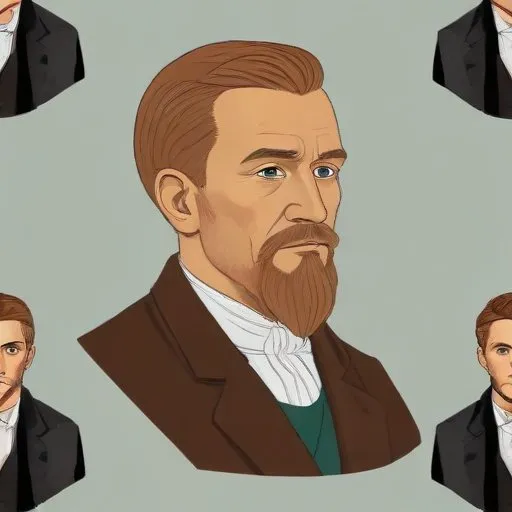
Developed the Three-Age System, categorizing artifacts into Stone, Bronze, and Iron Ages, revolutionizing archaeology and understanding of human history.
Christian Jrgensen Thomsen, a Danish antiquarian, is credited with developing the three-age system of European antiquity, a groundbreaking approach that divided prehistory into three distinct periods: Stone Age, Bronze Age, and Iron Age. This pioneering work, which presented artifacts chronologically, allowed for a better understanding of the evolution of human societies and cemented Thomsen's place as a leading figure in archaeology.
Born in Copenhagen in 1788, Thomsen came from a wealthy merchant family. As a young man, he traveled to Paris, where he developed an interest in coin collecting. This fascination with numismatics laid the foundation for his later work in archaeology, as it helped him develop an awareness of stylistic changes over time.
In 1816, Thomsen was appointed head of antiquarian collections, which later became the National Museum of Denmark in Copenhagen. While organizing and classifying the antiquities for exhibition, he decided to present them chronologically according to the three-age system. This innovative approach allowed for a more accurate understanding of the timeline of human history, enabling scholars to date artifacts with greater precision.
Thomsen's work on the three-age system led to his publication of the Guideline to Nordic Antiquity in 1836, a comprehensive treatise on the subject. An English translation followed in 1848, making his work accessible to a broader audience. Additionally, Thomsen wrote one of the first systematic treatises on gold bracteates of the Migration period, demonstrating his expertise in the field of archaeology.
Thomsen's approach to archaeology was rooted in his recognition of the importance of examining objects from closed finds. By studying the associations between stylistic changes, decoration, and context, he was able to determine the relationships between common artifacts for various periods. This methodology, which focused on the analysis of artifacts within their original contexts, allowed for a more accurate understanding of the past.
Christian Jrgensen Thomsen's contributions to archaeology have had a lasting impact on the field. His three-age system has become a cornerstone of archaeological research, enabling scholars to better understand the development of human societies. As a pioneer in the field, Thomsen's work has inspired generations of archaeologists, ensuring his legacy as one of the most influential figures in the history of archaeology.
Thomsen's life was marked by several significant events, including his appointment as head of antiquarian collections in 1816 and the publication of his groundbreaking work, Guideline to Nordic Antiquity, in 1836. These milestones highlight Thomsen's dedication to his work and his contributions to the field of archaeology.
Christian Jrgensen Thomsen passed away on May 21, 1865, leaving behind a legacy that continues to shape our understanding of the past.
Born in 1588
A 17th-century Danish physician and historian who cataloged and studied ancient Scandinavian artifacts, making significant contributions to the field of antiquarianism. His work laid the foundation for modern archaeological and historical research.
Born in 1779
A leading figure in the Danish Golden Age of literature, he wrote influential plays and poems that explored themes of national identity and romanticism. His works are still widely studied and performed in Denmark today.
Born in 1805
A Danish master of fairy tales, crafting whimsical stories like "The Little Mermaid" and "The Ugly Duckling" that have captivated readers for generations. His works have become an integral part of Western cultural heritage.
Born in 1813
A Danish philosopher and author who is considered the father of existentialism, known for his philosophical and theological writings that emphasized individualism and subjective experience.
Born in 1770
A renowned Danish sculptor and academic, he is most known for his exquisite neoclassical sculptures that adorned European palaces and museums, showcasing his mastery of classical forms and techniques.
Born in 1631
Governor-general of Norway during the Napoleonic Wars, known for maintaining Norway's autonomy and independence. He played a crucial role in shaping Norway's future as a sovereign state.
