


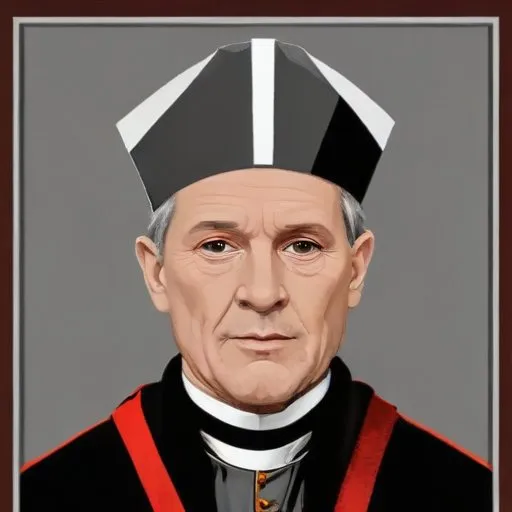
A 17th-century German Catholic bishop who ruled the Prince-Bishopric of Bamberg and was a prominent figure in the Counter-Reformation. He's known for his role in the witch hunts and trials in Bamberg.
Christoph Franz von Buseck, a prominent figure in the Roman Catholic Church, is remembered as the last Prince-Bishop of Bamberg, serving from 1794 to 1805. During his tenure, he navigated the complexities of the French Revolution and the subsequent secularization of the Holy Roman Empire, ultimately surrendering his temporal power to the Bavarian state.
Born on December 28, 1724, in Jagstberg, von Buseck was the son of Ernst Johann Philipp Hartmann von Buseck and Mary Ann. Although little is known about his early life, his noble lineage and family connections played a significant role in shaping his future.
Von Buseck's election as Prince-Bishop of Bamberg on April 7, 1794, marked a significant turning point in his life. He was ordained to the priesthood and consecrated as a bishop by his nephew, Georg Karl von Fechenbach, the Prince-Bishop of Würzburg, on August 16, 1795. However, his leadership was marred by weakness and indecision, leading to his eventual flight from Bamberg during the French invasion in 1796.
Von Buseck's attempts to flee the turmoil in Bamberg led him to Prague and later to Saalfeld, as the French occupation spread throughout the region. He eventually returned to Bamberg in 1800 and appointed his nephew as his coadjutor bishop and successor. The German mediatization of 1802-1803, which abolished the Holy Roman Empire's ecclesiastical principalities, led to the occupation of Bamberg by Bavaria and the subsequent loss of von Buseck's temporal power.
Despite being stripped of his temporal power, von Buseck remained the Bishop of Bamberg until his death on September 28, 1805. He was succeeded by his nephew, who died in 1808, leaving the See of Bamberg vacant until 1818. The Bavarian Concordat of 1817 elevated Bamberg to an archbishopric, marking a new era for the diocese.
Von Buseck's life and tenure as Bishop of Bamberg were deeply intertwined with the significant events of the late 18th and early 19th centuries. His experiences reflect the complexities of the period, including the French Revolution, the decline of the Holy Roman Empire, and the rise of nationalism in Europe.
Through his life and legacy, Christoph Franz von Buseck serves as a testament to the complexities and uncertainties of the late 18th and early 19th centuries. His experiences as the last Prince-Bishop of Bamberg continue to offer valuable insights into the history of the Roman Catholic Church and the broader political and social landscape of Europe during this period.
