


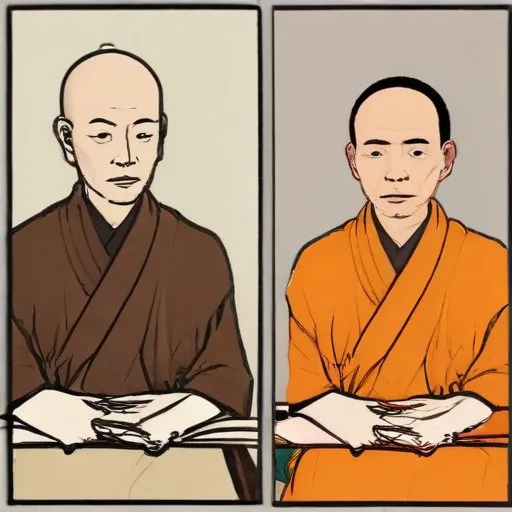
A 16th-century Korean Buddhist monk who wrote influential philosophical texts on Zen Buddhism, leaving a lasting impact on Korean thought and culture.
Chunseong, born Lee Changnim, was a Korean Buddhist monk, scholar, poet, writer, and philosopher who left an indelible mark on Korean Buddhism. He is revered for his profound contributions to Buddhist literature, philosophy, and education, earning him the esteemed title of "Hwaeom monk."
Chunseong was born on March 30, 1891, in Inje county, Gangwon Province, to a tenant farmer father, Lee Inoh, and mother, Lady Park of Milyang. He was the fifth son of the Pyeongchang Lee clan. His Dharma name, Chunseong, would eventually become synonymous with wisdom and enlightenment.
At the tender age of 15, Chunseong became a Buddhist monk, apprenticing under the esteemed Han Yongun at the famous Baekdamsa temple in Inje. His exceptional aptitude for Buddhist scriptures, particularly the Hwaeomgyeong and Geumganggyeong, earned him recognition as a prodigy among his peers.
In 1918, Chunseong's teacher, Han Yongun, published Yusim, a series of magazines aimed at making Buddhism more accessible to the youth. However, Yongun's involvement with the March 1st Movement led to his imprisonment in 1919. Undeterred, Chunseong demonstrated unwavering loyalty to his teacher, frequently visiting him in prison and providing essential supplies.
Chunseong's written works include poetry, prose, and philosophical treatises, showcasing his mastery of language and Buddhist philosophy. His writings not only demonstrate his erudition but also provide valuable insights into Korean Buddhist thought and culture.
Chunseong's contributions to Korean Buddhism have had a profound impact on modern society, shaping the country's spiritual landscape and inspiring future generations of Buddhist scholars and practitioners.
Within the Korean Buddhist tradition, Chunseong's work is regarded as a testament to the power of devotion, scholarship, and compassion. His legacy continues to influence Korean Buddhism, ensuring his place among the pantheon of revered Buddhist scholars and thinkers.
Chunseong's unique blend of Buddhist scholarship, literary prowess, and philosophical acumen sets him apart from his contemporaries. His contributions have enriched Korean Buddhism, making him an invaluable figure in the country's intellectual and spiritual heritage.
Chunseong's remarkable life, characterized by unwavering dedication to his teacher and the pursuit of Buddhist knowledge, has cemented his status as one of Korea's most esteemed Buddhist scholars and thinkers.
Born in 1200
Founder of S?t? Zen, a school of Zen Buddhism that emphasizes shikantaza, or "just sitting" meditation, and is known for his teachings on the importance of mindfulness and being present in the moment.
