


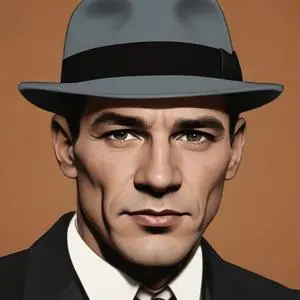
Notorious outlaw and bank robber during the Great Depression, known for his reckless crimes and romanticized media portrayal.
Clyde Barrow, along with his partner in crime Bonnie Parker, is etched in American history as one of the most notorious outlaws of the Great Depression era. His exploits as a bank robber, murderer, and folk hero have captivated the imagination of the public, earning him a permanent place in the annals of crime and infamy.
Born on March 24, 1909, in Telico, Texas, Clyde Barrow grew up in a poor farming family. His early life was marked by poverty and hardship, which likely contributed to his eventual descent into a life of crime. Barrow's first brush with the law came in 1926 when he was arrested for burglary. This initial offense set the tone for a lifetime of criminal activity.
In the early 1930s, Barrow formed a gang that included his brother Marvin "Buck" Barrow, his sister-in-law Blanche Barrow, and the infamous Bonnie Parker. Together, they embarked on a string of bank robberies, shootouts, and murders that left a trail of terror across the United States. The Barrow Gang's notoriety soared as they evaded capture, earning them a reputation as some of the most elusive and feared outlaws of the time.
Between 1931 and 1934, the Barrow Gang committed a staggering number of crimes, including bank robberies, store robberies, and kidnappings. Their most notorious exploit was the 1932 robbery of the Neuhoff Bakery in Dallas, which resulted in the murder of a police officer. This crime, coupled with the brutal killing of a young highway patrolman in 1934, solidified their reputation as ruthless and merciless criminals.
On May 23, 1934, Clyde Barrow and Bonnie Parker's crime spree came to a brutal end. Ambushed by a posse of law enforcement officials in Bienville Parish, Louisiana, the duo was killed in a hail of bullets. The event was both shocking and cathartic, as it brought an end to the terror they had unleashed on the American public.
Clyde Barrow's legend has endured long after his death, inspiring numerous books, films, and songs. The 1967 film "Bonnie and Clyde," starring Faye Dunaway and Warren Beatty, cemented his status as a folk hero, forever enshrining him in popular culture. The outlaw's reputation as a rebellious anti-hero has captivated generations, ensuring his place in the pantheon of American cultural icons.
Barrow's relationship with Bonnie Parker remains one of the most intriguing aspects of his life. The two outlaws were deeply in love, with Parker often participating in their criminal activities. Their bond was marked by a deep affection and loyalty, which only intensified as they faced increasing danger and scrutiny.
One of Barrow's most famous quotes, often attributed to him, is: "We rob banks for a living, and it's a living like any other." This statement, whether apocryphal or not, perfectly captures the outlaw's brazen attitude and defiant spirit.
Barrow's life and crimes must be viewed within the context of the Great Depression, a time of unprecedented economic hardship and social upheaval. His notoriety served as a dark reflection of the era's poverty, desperation, and lawlessness. As a cultural icon, Barrow's legacy is a complex mixture of fascination and revulsion, reflecting America's ongoing fascination with the darker aspects of human nature.
Born in 1910
Notorious outlaw and poet, known for her criminal exploits with Clyde Barrow during the Great Depression, romanticized in folklore and popular culture.
Born in 1911
A Jamaican cricketer who played for the West Indies team, known for his impressive bowling skills and taking 95 wickets in his Test cricket career.
