


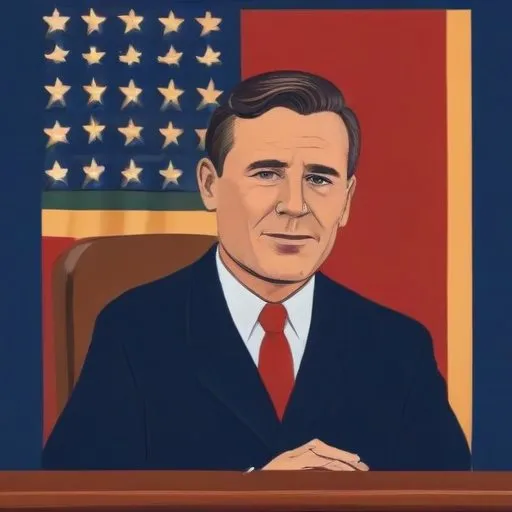
A decorated World War II veteran who later became a governor and senator, known for his folksy charm and progressive policies. He was a strong advocate for education and healthcare reform.
Dale Bumpers, the 38th Governor of Arkansas and a United States Senator, left an indelible mark on American politics with his unwavering commitment to civil rights, education, and progressive values. Throughout his illustrious career, Bumpers championed the causes of integration, medical research, and environmental protection, earning him a revered place in the annals of Arkansas and American history.
Born on August 12, 1925, in Charleston, Arkansas, Dale Bumpers was the son of William Rufus Bumpers, a former Arkansas House of Representatives member, and Lattie Jones Bumpers. After serving in the United States Marine Corps during World War II, Bumpers attended the University of Arkansas and later graduated from Northwestern University Law School in Chicago in 1951.
Bumpers' entry into politics began with his service as Charleston city attorney from 1952 to 1970. During this period, he played a pivotal role in convincing the school board to integrate public schools, making Charleston the first School District in the former Confederate South to do so. This achievement earned him recognition as a champion of civil rights and paved the way for his future political successes.
Bumpers served as the Governor of Arkansas from 1971 to 1975, where he focused on education reform, environmental protection, and infrastructure development. His commitment to progressive values and his ability to work across party lines earned him widespread popularity, leading to his election as a United States Senator in 1974. During his 24-year tenure in the Senate, Bumpers continued to advocate for civil rights, healthcare, and environmental protection, becoming a respected voice in the Democratic Party.
Bumpers' legacy extends beyond his legislative achievements. His commitment to civil rights, education, and environmental protection has inspired generations of leaders and citizens. His tireless efforts to promote progressive values have contributed significantly to the advancement of social justice and equality in Arkansas and beyond.
Bumpers passed away on January 1, 2016, leaving behind a legacy of public service and a family that includes his wife, Betty, and their six children. After retiring from politics, Bumpers continued to practice law and remained involved in various charitable and educational initiatives.
Dale Bumpers' unwavering dedication to the principles of justice, equality, and education has left an indelible mark on American politics. His commitment to integration, medical research, and environmental protection continues to inspire future generations of leaders and citizens. As a champion of progressive values, Bumpers' legacy serves as a beacon of hope for a more just and equitable society.
79 Years Old
The 42nd President of the United States, a charismatic leader who reformed healthcare and economy, and infamous for his scandals.
78 Years Old
A highly influential American politician and diplomat who served as Secretary of State and First Lady, known for her advocacy on women's rights and international diplomacy.
78 Years Old
The 45th Vice President of the United States and Nobel Prize laureate is a prominent advocate for environmental protection, particularly climate change awareness, and has produced influential documentaries on the subject.
83 Years Old
The 46th President of the United States, currently serving as the leader of the country, known for his efforts in addressing climate change and promoting unity.
70 Years Old
A former Baptist minister who served as Governor of Arkansas from 1996 to 2007, known for his conservative views and presidential bids. He's also a TV commentator and author.
Born in 1924
Legendary college football coach and broadcaster, known for his iconic voice and analysis on ABC and ESPN, leading the Arkansas Razorbacks to a national championship in 1964.
Born in 1910
The 36th Governor of Arkansas, a segregationist who deployed National Guard troops to prevent African American students from integrating into Little Rock Central High School in 1957. He sparked a major civil rights crisis, prompting federal intervention.
