


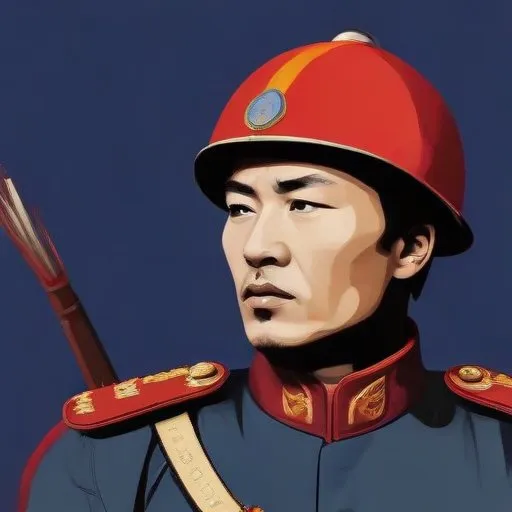
Mongolian revolutionary leader who led the country's struggle for independence from China and established the Mongolian People's Party, playing a key role in shaping the country's modern history.
Damdin Skhbaatar is revered as the founding father of Mongolia's revolution, a stalwart leader who spearheaded the Outer Mongolian Revolution of 1921. He was a pioneering figure in the Mongolian People's Party, instrumental in liberating his country from Chinese rule and paving the way for Mongolia's independence.
Skhbaatar, born on February 2, 1893, in present-day Ulaanbaatar, was the third of four children to a family of humble means. His parents, who had deserted their home banner in Setsen Khan aimag, struggled to make ends meet, with his father working odd jobs and as a day laborer.
At the age of six, Skhbaatar's family moved close to the Russian consulate, where he learned to speak some Russian by playing with Russian children. This early exposure to a foreign language would later prove invaluable in his revolutionary endeavors.
At 14, Skhbaatar received an education from Zaisan Jamyan, a watershed moment that would shape his future. He continued to work as a proxy rider until he was drafted into Mongolia's new army in 1911, following the country's first declaration of independence.
In 1912, Skhbaatar was transferred to the military school at Khujirbulan, established by Russian advisers to the Bogd Khan. His exceptional military tactics and skills in riding and shooting earned him the respect of his comrades, and he soon became a platoon leader of the machine gun company at Khujirbulan.
Skhbaatar's military prowess and leadership qualities propelled him to the forefront of Mongolia's struggle for independence. He played a crucial role in the Outer Mongolian Revolution of 1921, leading the Mongolian partisan army that captured Khree, a milestone that cemented his status as a national hero.
In 1913, Skhbaatar established his own household with his wife, Yanjmaa, with whom he had a son in 1911. Despite initial objections from Yanjmaa's parents due to Skhbaatar's poverty, the couple persevered, and their relationship became a testament to his dedication to his family and country.
Damdin Skhbaatar's contributions to Mongolia's independence and revolution are immeasurable. He is hailed as the Father of Mongolia's Revolution, a title that reflects his selfless dedication to his country's liberation. His legacy continues to inspire generations of Mongolians, serving as a beacon of hope and resilience in the face of adversity.
Today, Skhbaatar's image adorns Mongolia's currency, and his birthday, February 2, is celebrated as a national holiday. His life and achievements serve as a powerful reminder of the importance of patriotism, courage, and determination in the pursuit of freedom and independence.
"We will not be slaves to the Chinese, we will not be slaves to the Russians. We will be free, and we will be Mongolians!" - Damdin Skhbaatar
These words, spoken during the height of the Outer Mongolian Revolution, encapsulate Skhbaatar's unwavering commitment to his country's independence and sovereignty.
68 Years Old
The 3rd President of Mongolia, a lawyer-turned-politician who served from 2005 to 2009, known for his efforts to strengthen the country's economy and democratic institutions.
