


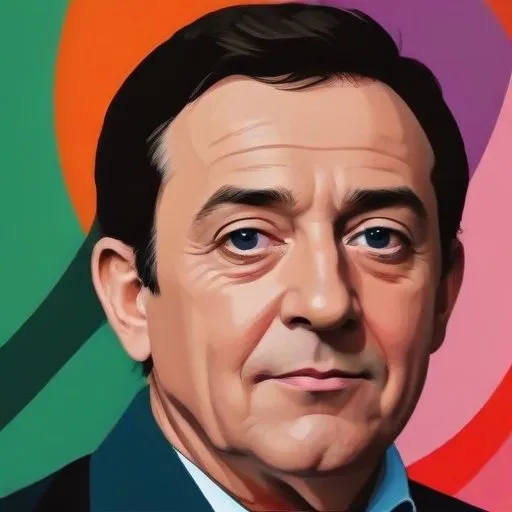
A French artist known for his conceptual and minimalist works, often incorporating stripes and public installations to explore the relationship between art and its environment.
Known for his striking, vertically striped installations that seamlessly integrate with architectural spaces, Daniel Buren has been a driving force in the art world for over five decades. His unique approach to site-specific art has made him a household name, with works that challenge the boundaries between art and its environment.
Born on March 25, 1938, in Boulogne-Billancourt, France, Buren's fascination with art began at a young age. He honed his skills at the Ecole Nationale Supérieure des Métiers d'Art in Paris, graduating in 1960. The early 1960s saw him experimenting with traditional painting, but it wasn't until 1965 that he stumbled upon his signature style – the 8.7 cm-wide vertical stripes that would become synonymous with his name.
Buren's use of stripes was more than just an aesthetic choice; it was a deliberate attempt to contextualize art within its surroundings. By employing a popular French fabric motif, he aimed to create a visual language that would interact with the space around it. This innovative approach allowed him to challenge traditional notions of art as an autonomous entity, instead highlighting the process of creation itself.
Some of Buren's most notable works include:
Buren's groundbreaking work has been recognized with numerous awards, including:
Buren's contributions to conceptual art, minimalism, and site-specific installations have had a profound impact on the art world. His emphasis on contextualization has inspired a new generation of artists to rethink the relationship between art, architecture, and the viewer.
Buren's work raises important questions about the nature of art, its relationship to its environment, and the role of the artist as a mediator between the two. By challenging traditional notions of art as a self-contained entity, he has expanded our understanding of the creative process and its implications.
Daniel Buren's unwavering commitment to pushing the boundaries of art has cemented his position as one of the most important artists of our time. As his work continues to inspire and challenge, it serves as a testament to the power of art to transform our understanding of the world around us.
Through his innovative approach to art, Daniel Buren has left an indelible mark on the art world, challenging our perceptions and inspiring new generations of artists to rethink the possibilities of creative expression.
72 Years Old
A renowned artist creating large-scale, thought-provoking sculptures that explore themes of materiality, space, and human experience. His works often feature biomorphic forms, vibrant colors, and interactive elements.
86 Years Old
A pioneering figure in modern sculpture, known for large-scale, site-specific installations that challenge viewers' perceptions of space and materiality.
97 Years Old
A pioneer of conceptual art, creating site-specific installations and sculptures that explore the relationship between art and language, often featuring geometric shapes and minimalist forms.
93 Years Old
A pioneer of minimalist art, he created site-specific installations using fluorescent light to transform spaces and challenge traditional notions of sculpture. His innovative use of light as a medium has had a lasting impact on the art world.
98 Years Old
A pioneer of Minimalist art, creating simple, industrial-looking sculptures and installations that explore space, materiality, and perception. Known for challenging traditional notions of art and its display.
90 Years Old
A pioneering artist who blurred the lines between sculpture, painting, and drawing, creating innovative and emotive works that explored the human experience.
95 Years Old
A pioneer of minimalist and conceptual art, known for blurring the lines between sculpture, performance, and installation, often using industrial materials and everyday objects.
84 Years Old
A pioneering artist known for pushing boundaries in sculpture, performance, and installation, often exploring themes of identity, language, and the human condition.
