


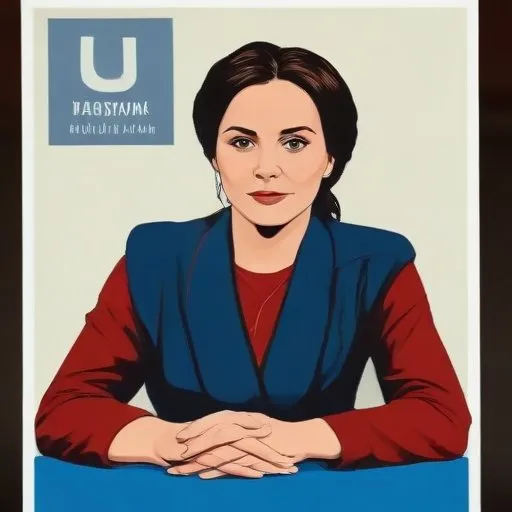
A Ukrainian journalist and author who wrote about women's rights and social issues in the early 20th century, leaving a lasting impact on Ukrainian literature and feminism.
Daryna Dmytrivna Polotniuk, better known by her pen name Iryna Vilde, is a revered Ukrainian and Soviet writer and correspondent, celebrated for her remarkable contributions to Ukrainian literature. Her works are now considered classics, offering a unique glimpse into the lives of the Western Ukrainian intelligentsia, petty bourgeoisie, and students during the early 20th century.
Born on May 5, 1907, in Chernivtsi, Austria-Hungary, Vilde was the daughter of Dmytro Makohon, a schoolteacher and writer, and Adolphina Janiszewska, a teacher. She graduated from the Stanislav private school in 1927 and later from the University of John II Casimir in Lwow (now University of Lviv) in 1932. Despite being expelled from school in 1930 as part of the anti-Ukrainian Pacification operation, Vilde persevered and went on to achieve academic success.
Vilde's writing career spanned over five decades, during which she published numerous short stories, novels, and essays. Her first short story, "Povist zyttia" (Life Story), was published in 1930. In 1935, she published her novel "Metelyky na shpylkakh" (Pinned Butterflies) under the pseudonym Iryna Vilde.
During the war period and after the unification of Western Ukraine with the Ukrainian SSR, Vilde continued to explore familiar themes of family life in bourgeois society. Her works are characterized by a vast array of characters, including protagonists from all public spheres of Galicia, such as the clergy, employees, workers, peasantry, petty bourgeoisie, as well as information on the activities of various parties and public organizations.
Vilde was married to Yevhen Polotniuk, with whom she had two children. Tragically, her husband was executed by the Gestapo in 1943. Despite this personal tragedy, Vilde continued to write, leaving behind a legacy of literary works that continue to inspire and educate generations.
Iryna Vilde's contributions to Ukrainian literature are immeasurable. Her works offer a unique window into the lives of Ukrainians during the early 20th century, providing valuable insights into the social, cultural, and political context of the time. Vilde's writing has been widely acclaimed, and her works have been translated into multiple languages, cementing her status as a Ukrainian literary icon.
Vilde's writing is characterized by her witty observations and insightful commentary on the human condition. One of her most memorable quotes is: "The truth is not always pleasant, but it is always necessary."
Vilde's literary contributions have been recognized with numerous awards and honors. She was posthumously awarded the title of Honored Cultural Worker of Ukraine in 1982.
Iryna Vilde's life and works serve as a testament to her unwavering dedication to Ukrainian literature and culture. Her legacy continues to inspire and educate, ensuring her place as one of Ukraine's most celebrated writers and correspondents.
Born in 1856
A Ukrainian literary icon, celebrated for his poetry and novels that explored themes of social justice, Ukrainian identity, and folk culture. His works are considered a cornerstone of Ukrainian literature.
Born in 1842
A Ukrainian musical mastermind who composed and conducted works that showcased his country's rich cultural heritage, and was a pioneer in promoting Ukrainian music and arts.
