


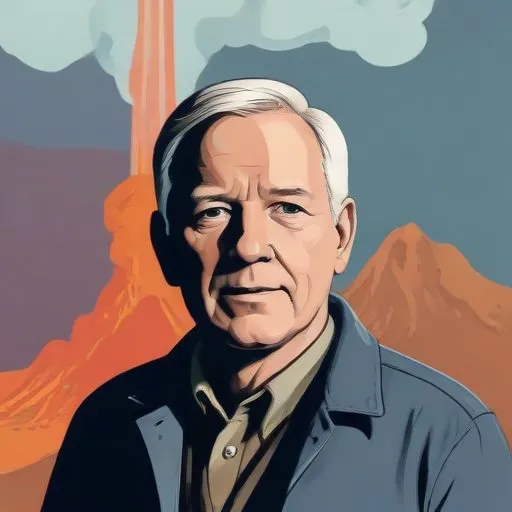
A volcanologist who predicted the 1980 Mount St. Helens eruption, saving countless lives, and is remembered for his heroic last words "Vancouver! Vancouver!"
David A. Johnston was a renowned American volcanologist who made the ultimate sacrifice while monitoring the 1980 eruption of Mount St. Helens, transmitting his final words, "Vancouver! Vancouver! This is it!" before being swept away by a lateral blast. He was the first to report the eruption, and his bravery and dedication to his work saved thousands of lives.
Johnston's fascination with volcanology took him across the United States, where he studied the Augustine Volcano in Alaska, the San Juan volcanic field in Colorado, and long-extinct volcanoes in Michigan. His meticulous and talented approach to analyzing volcanic gases and their relationship to eruptions earned him the respect and admiration of his peers.
Johnston's enthusiasm and positive attitude made him a beloved figure among his coworkers, who lauded his character and dedication to his craft. He firmly believed that scientists must take risks to help protect the public from natural disasters, and his work, along with that of his fellow USGS scientists, was instrumental in convincing authorities to close Mount St. Helens to the public before the 1980 eruption.
Johnston's story has become intertwined with the popular image of volcanic eruptions and their threat to society, and a part of volcanology's history. He is one of only two American volcanologists known to have died in a volcanic eruption, along with his mentee Harry Glicken.
Following his death, Johnston was commemorated in several ways, including a memorial fund established in his name at the University of Washington to fund graduate-level research in volcanology. His legacy continues to inspire future generations of scientists and volcanologists, who strive to follow in his footsteps and make a difference in the world.
Johnston's work and sacrifice were driven by his strong sense of responsibility to protect the public from natural disasters. He believed that scientists must take risks and push the boundaries of knowledge to make a positive impact on society.
His legacy serves as a testament to the power of human courage and dedication, and continues to inspire future generations of scientists to make a difference in the world.
Johnston's work and sacrifice have had a lasting impact on modern society, raising awareness about the dangers of volcanic eruptions and the importance of scientific research in understanding and mitigating natural disasters.
His story has also inspired a new generation of scientists, encouraging them to pursue careers in volcanology and related fields, and to continue his legacy of bravery and dedication.
Born in 1893
A pioneering scientist who discovered deuterium, a heavy isotope of hydrogen, and later contributed to the discovery of many other elements, revolutionizing our understanding of the universe.
