


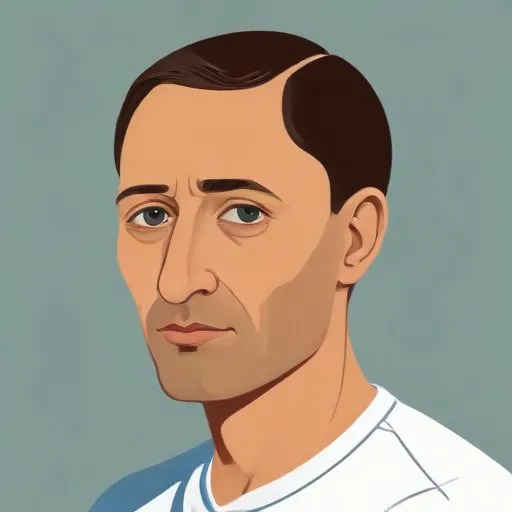
A Ukrainian avant-garde author and illustrator, known for his vibrant and fantastical works that blended folk art and Futurism, influencing the development of Ukrainian modernism.
David Burliuk, a Ukrainian-born poet, artist, and publicist, is widely regarded as the father of Russian Futurism, a revolutionary art movement that rejected traditional norms and sought to create a new, avant-garde aesthetic. Through his poetry, paintings, and publicist activities, Burliuk played a pivotal role in shaping the trajectory of Russian Futurism, influencing a generation of artists and writers.
Born on July 21, 1882, in the village of Riabushky, Ukraine, Burliuk came from an artistically inclined family. His brothers, Nikolai and Volodimir, were talented artists, and his mother, Ludmyla Mikhnevich, was of ethnic Belarusian descent. The Burliuk family partly descended from Ukrainian Cossacks, who held premier positions in the Hetmanate.
Burliuk's artistic journey began in 1898, when he enrolled in the Kazan and Odesa art schools. He later studied at the Royal Academy in Munich, where he was recognized for his unique talent by Anton Azhbe, his professor. Azhbe described Burliuk as a "wonderful wild steppe horse," reflecting his exuberant and extroverted character.
In 1907, Burliuk made contact with the Russian art world, befriending Mikhail Larionov, a prominent artist and theorist. Together, they organized an exhibition with the group Zveno (The Link) in Kiev, which, although it failed to gain traction, marked the beginning of their collaborative efforts to revolutionize Russian art.
In 1908, Burliuk and Larionov, along with other avant-garde artists, including his brother Volodymyr and Aleksandra Ekster, organized an exhibition in Chernianka, which became a turning point in their artistic careers. The exhibition's success led to a new wave of avant-garde art, which rejected traditional representational art forms and embraced a more radical, experimental approach.
Burliuk's poetry and artwork were instrumental in shaping the Russian Futurist movement. His poetry, characterized by its innovative use of language and imagery, explored themes of modernity, technology, and urbanization. His paintings, often featuring bold colors and abstract forms, reflected his fascination with the machine age and the dynamism of modern life.
One of Burliuk's most notable works is his portrait of his future wife, Marussia, painted against a backdrop of flowers. This piece, created in 1909, showcased his unique style, which blended elements of Futurism, Cubism, and Symbolism.
Burliuk's contributions to Russian Futurism had a profound impact on modern art, influencing a wide range of artists, from Kazimir Malevich to Vladimir Mayakovsky. His emphasis on experimentation, innovation, and artistic freedom paved the way for future generations of artists, poets, and writers.
Burliuk's legacy extends beyond the art world, as his ideas about the role of art in society and his emphasis on the importance of creative freedom continue to inspire artists, writers, and thinkers around the world.
David Burliuk's groundbreaking work and innovative spirit continue to inspire and influence artists, writers, and thinkers to this day, cementing his status as the father of Russian Futurism.
Born in 1893
A Russian avant-garde artist who revolutionized poetry and theater with his bold, futuristic style and passionate performances. He's most famous for his vibrant, propaganda-inspired posters and poems that captured the spirit of the Russian Revolution.
Born in 1878
A Ukrainian painter and theorist who founded the Suprematist movement, creating geometric abstract works that explored the emotional and spiritual properties of color. They're most known for their iconic "Black Square" painting.
36 Years Old
A Ukrainian/Russian volleyball player who won multiple Olympic and World Championship medals, known for her exceptional blocking skills and dominance on the court.
Born in 1881
A Russian avant-garde artist who pioneered Rayonism, a style that emphasized geometric forms and vibrant colors, and also designed sets for the Ballets Russes. His work blended art and theater, pushing boundaries in both fields.
Born in 1887
A dreamlike painter and poet who blended fantasy and reality, creating vibrant, emotive works that explored Jewish culture and the human experience.
Born in 1890
A pioneer of Constructivist art, creating innovative sculptures that explored space, material, and form, pushing the boundaries of modern art.
