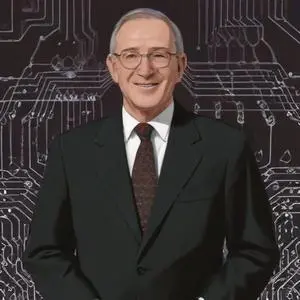
David Packard: The Visionary Behind Hewlett-Packard
The Pioneer of Silicon Valley
David Packard is renowned for co-founding Hewlett-Packard (HP), one of the world's leading technology companies, alongside Bill Hewlett in 1939. As the president, CEO, and chairman of the board, Packard played a pivotal role in shaping the company's success and leaving an indelible mark on the tech industry.
Early Life and Education
Born on September 7, 1912, in Pueblo, Colorado, Packard developed an interest in science, engineering, sports, and leadership from an early age. He attended Centennial High School and later graduated from Stanford University in 1934 with a Bachelor of Arts degree. At Stanford, he earned letters in football and basketball, was inducted into the Phi Beta Kappa Society, and became a Brother of the Alpha Delta Phi Literary Fraternity. It was during his time at Stanford that he met Lucile Salter, his future wife, and Bill Hewlett, his future business partner.
The Birth of Hewlett-Packard
In 1938, Packard returned to Stanford and earned a master's degree in electrical engineering. The following year, he and Hewlett founded HP in Packard's garage with an initial investment of $538. The name Hewlett-Packard was decided by the flip of a coin. The company's early success was fueled by its innovative products, including audio oscillators, which were later used by
Walt Disney in the production of Fantasia.
Career Highlights and Major Works
- Packard served as president of HP from 1947 to 1964, CEO from 1964 to 1968, and chairman of the board from 1964 to 1968 and again from 1973 to 1993.
- In 1969, he was appointed U.S. Deputy Secretary of Defense during the Nixon administration, a position he held until 1971.
- From 1976 to 1981, Packard served as president of the Uniformed Services University of the Health Sciences and chairman of its board of regents from 1973 to 1982.
Philosophical Contributions and Beliefs
Packard was a strong advocate for innovation, quality, and customer satisfaction. He emphasized the importance of teamwork, encouraging HP employees to share ideas and collaborate. His management philosophy, known as "The HP Way," emphasized the importance of trust, respect, and open communication within the organization.
Awards and Honors
Packard received numerous accolades for his contributions to business and society, including:
- The Presidential Medal of Freedom in 1988
- The National Medal of Science in 1983
- The IEEE Founders Medal in 1973
Personal Life and Philanthropy
Packard married Lucile Salter in 1938 and had four children: David, Nancy, Susan, and Julie. He was a devoted family man and philanthropist, supporting various causes, including education and healthcare. Packard passed away on March 26, 1996, leaving behind a legacy of innovation, leadership, and community service.
Legacy and Impact on Modern Society
David Packard's influence on the tech industry is immeasurable. He played a pivotal role in shaping Silicon Valley and inspiring generations of entrepreneurs and innovators. His commitment to quality, innovation, and customer satisfaction has had a lasting impact on the way businesses operate. Today, HP remains one of the world's leading technology companies, a testament to Packard's vision and leadership.
FAQ
What was David Packards role in the development of Hewlett-Packard?
David Packard co-founded Hewlett-Packard (HP) with William Hewlett in 1939, and played a key role in its growth into a multinational technology company. He served as its CEO and later chairman.
What were David Packards contributions to the field of engineering?
David Packard made significant contributions to the development of electronic equipment, including the invention of the audio oscillator, which helped launch HPs success.
How did David Packards management style shape HPs culture?
Packards management style emphasized innovation, simplicity, and customer focus, which helped shape HPs distinctive company culture. He also encouraged employee ownership and participatory management.
What was David Packards role in the US government?
David Packard served as the US Deputy Secretary of Defense from 1969 to 1971, playing a key role in shaping the countrys defense policy during the Nixon administration.
What was David Packards philanthropic legacy?
David Packard was a committed philanthropist, co-founding the David and Lucile Packard Foundation, which focused on education, science, and conservation. He also supported various educational institutions and medical research initiatives.