


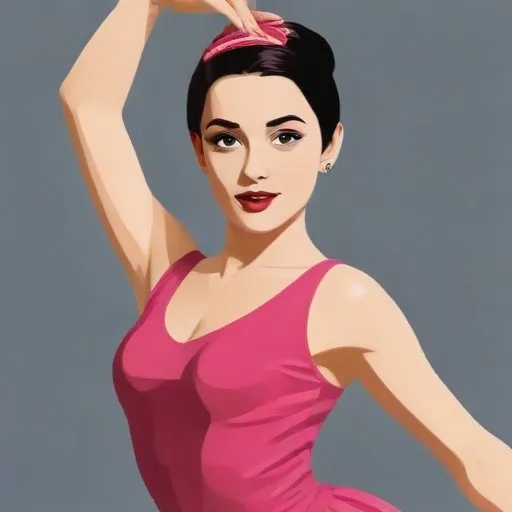
An Italian prima ballerina and actress, she was a celebrated performer in the 1950s and 1960s, starring in films and ballets, and known for her elegance and poise.
Delia Scala was a renowned Italian ballerina, actress, and singer who left an indelible mark on the world of commedia musicale, a unique Italian musical genre that combines music, dance, and comedy. Born Odette Bedogni on September 25, 1929, Scala's illustrious career spanned over two decades, mesmerizing audiences with her captivating performances on stage and screen.
Scala's journey to stardom began at a young age when she enrolled in La Scala Ballet School in Milan, where she honed her ballet skills for seven years. Following World War II, she transitioned to the silver screen, adopting the stage name Delia Scala and starring in a string of successful films, including Difficult Years (1948), Side Street Story (1950), and Rome 11:00 (1952).
In 1954, Scala made her theatrical debut in Giove in doppiopetto, a groundbreaking production that marked the inception of commedia musicale. This innovative genre, created by playwrights Pietro Garinei and Sandro Giovannini, along with musician and songwriter Gorni Kramer, revolutionized Italian entertainment. Scala's involvement in this pioneering production cemented her status as a leading lady of commedia musicale.
Scala's theatrical career was punctuated by a series of successful productions, including Buonanotte Bettina (1956), L'adorabile Giulio (1957), Un trapezio per Lisistrata (1958), and Delia Scala Show (1960). Her performances were often accompanied by prominent actors, such as Walter Chiari, Carlo Dapporto, and Nino Manfredi.
In 1956, Scala ventured into television, starring in the popular show Lui e Lei alongside Nino Taranto. She later co-hosted Canzonissima with Nino Manfredi and Paolo Panelli from 1959 to 1960. As her fame grew, Scala received offers to perform on Broadway, but she surprisingly declined, choosing instead to retire from live performances in 1965.
In 1966, Scala married and stepped out of the public eye to focus on her family. Her decision to prioritize her personal life over her illustrious career was a testament to her values and character. Although she never returned to the stage or screen, Delia Scala's legacy continues to inspire generations of performers and entertainers.
Delia Scala's remarkable career not only paved the way for future generations of Italian performers but also contributed significantly to the development of commedia musicale. Her dedication to her craft, her versatility, and her courage to break away from the spotlight have cemented her place as a true icon of Italian entertainment.
88 Years Old
A renowned Russian-French dancer and choreographer who revolutionized ballet with his powerful stage presence and iconic performances, particularly in productions like "Swan Lake" and "Romeo and Juliet".
78 Years Old
A renowned Russian-American dancer, choreographer, and actor who revolutionized ballet with his athletic style and charismatic stage presence, starring in films like "The Turning Point" and "White Nights".
Born in 1925
A renowned Russian-Lithuanian ballerina, choreographer, actress, and director, celebrated for her powerful stage presence and iconic performances with the Bolshoi Ballet. She is a cultural icon in the world of dance.
36 Years Old
A Ukrainian ballet dancer known for his powerful stage presence and rebellious attitude, who has performed with top companies like the Royal Ballet and Stanislavsky Theatre. He's also a social media sensation, using his platform to showcase his art and challenge traditional ballet norms.
87 Years Old
A renowned Russian ballerina celebrated for her technical precision and emotional depth, particularly in classical roles like Giselle and Swan Lake.
85 Years Old
A renowned Russian ballerina, choreographer, and actress, celebrated for her iconic performances in classical ballets like Giselle and Swan Lake, and her innovative choreography.
63 Years Old
A renowned Italian ballerina celebrated for her technical precision and emotional depth on stage, particularly in iconic roles like Juliet in Romeo and Juliet.
