


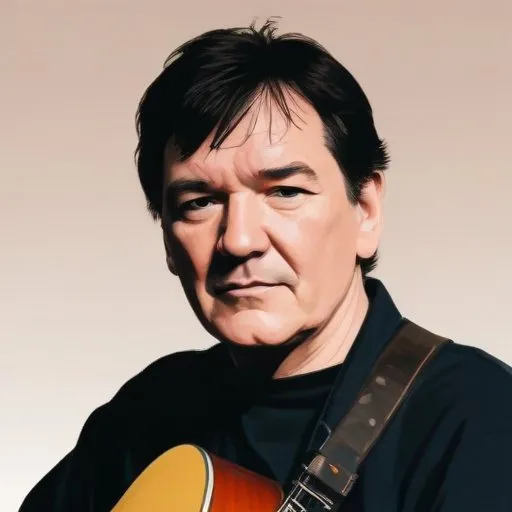
A renowned folk musician celebrated for his powerful, poignant songwriting and masterful guitar work, which often addressed social justice and Scottish heritage.
Dick Gaughan, a Scottish musician, singer, and songwriter, is renowned for his powerful voice and poignant lyrics that evoke the spirit of social protest. With a career spanning over five decades, he has established himself as one of Scotland's leading singer-songwriters, weaving a rich tapestry of folk, social commentary, and activism.
Born on May 17, 1948, in Glasgow's Royal Maternity Hospital, Gaughan spent his early years in Rutherglen, South Lanarkshire, and later moved to Leith, a port on the outskirts of Edinburgh, with his family. The eldest of three children, he was surrounded by the music of Scotland and Ireland, with his mother, a Highland Scot, speaking Gaelic and his father, a native of Leith, playing guitar.
Gaughan's paternal grandfather, a native of Erris, County Mayo, played the fiddle, while his paternal grandmother, a Glaswegian born to Irish parents, played button accordion and sang. This rich cultural heritage deeply influenced Gaughan's musical journey, instilling in him a strong sense of community spirit and working-class roots.
In his teens, Gaughan served an apprenticeship at a local paper mill, but his passion for music led him to turn professional in early 1970. He moved to London and started performing in folk clubs, eventually releasing his debut album, No More Forever, in 1971. The album featured traditional songs, including Hamish Henderson's "The John Maclean March," a tribute to the Glasgow socialist John Maclean.
Gaughan's music gained momentum in the 1970s, with his unique blend of folk, rock, and social commentary resonating with audiences. His collaborations with other musicians, including Aly Bain, Cathal McConnell, and Robin Morton, further solidified his reputation as a masterful singer-songwriter.
Gaughan's music is characterized by its strong social conscience, reflecting his deep commitment to social justice and activism. His songs often tackle themes of poverty, inequality, and working-class struggles, inspired by his own experiences growing up in a poverty-stricken community.
Through his music, Gaughan has championed causes such as anti-apartheid, anti-nuclear, and environmental movements, using his platform to raise awareness about pressing social issues.
Gaughan's discography boasts an impressive array of albums, including Kist o' Gold (1976), Coppers and Brass (1983), and Redwood Cathedral (1998). His critically acclaimed album, Lucky for Some (1992), won the BBC Folk Awards' Best Album category.
In addition to his solo work, Gaughan has collaborated with other notable musicians, including Billy Bragg, Ewan McLennan, and Karine Polwart, further cementing his reputation as a masterful singer-songwriter.
Gaughan's contributions to Scottish music and culture are immeasurable. His music has inspired generations of musicians, including Mark Knopfler, who has often cited Gaughan as a major influence.
Through his music and activism, Gaughan has helped to raise awareness about social issues, promoting greater understanding and empathy among his audience. His legacy continues to inspire and influence new generations of musicians, ensuring his impact on modern society will be felt for years to come.
Gaughan has received numerous awards and accolades for his contributions to music and social activism. In 2009, he was awarded an honorary doctorate from the University of St Andrews, recognizing his outstanding contributions to Scottish music and culture.
In 2013, Gaughan received the BBC Radio 2 Folk Awards' Lifetime Achievement Award, further solidifying his status as a Scottish musical icon.
Dick Gaughan's remarkable career has left an indelible mark on Scottish music and culture. His tireless activism and commitment to social justice have inspired countless musicians and audiences alike, ensuring his legacy will continue to resonate for generations to come.
As a torchbearer of Scottish folk music, Gaughan's work has not only preserved the rich cultural heritage of his homeland but has also inspired new generations of musicians to explore the boundaries of folk and social protest music.
In conclusion, Dick Gaughan's remarkable journey is a testament to the power of music and activism, leaving behind a rich cultural legacy that will continue to inspire and empower audiences for years to come.
68 Years Old
A folk-punk pioneer, known for blending protest songs with catchy melodies, inspiring social change through music.
85 Years Old
A British folk music legend, known for his innovative guitar playing and influential interpretations of traditional songs, inspiring generations of musicians.
50 Years Old
A British folk singer-songwriter and fiddler, known for blending traditional English music with contemporary styles and energetic live performances.
77 Years Old
A British folk-rock legend, renowned for his poetic songwriting, virtuosic guitar playing, and eclectic blend of traditional and contemporary styles. He's a highly influential figure in the singer-songwriter genre.
