


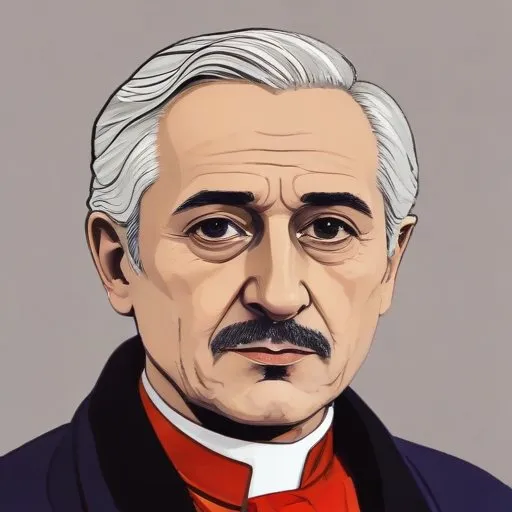
A prominent figure in 19th-century Romanian literature and politics, known for his romantic poetry and liberal ideals that shaped the country's cultural and political landscape.
Dimitrie Bolintineanu was a Romanian poet, diplomat, politician, and revolutionary, best known for his poems that fueled nationalist emotions during the unification of Wallachia and Moldavia. His works played a significant role in shaping the country's literary and political landscape in the 19th century.
Bolintineanu was born on January 14, 1819, in Bolintin-Vale, a village near Bucharest, to an Aromanian family. His father, Ienache Cosmad, was of Aromanian origin from Ohrid, and his mother was from Wallachia. After losing both parents in 1831, Bolintineanu was raised by his relatives and began working at a young age to support himself.
He started his career as a civil servant, working as a clerk at the State Secretariat in 1841 and later as a secretary at the department of Suddito Reasons in 1843. In 1844, he was raised to the rank of a Pitar boyar, overseeing the bakeries.
Bolintineanu's literary career took off in 1842 with the publication of his poem "A Young Girl on the Bed of Death," which was praised by Ion Heliade Rădulescu and later recited by Mihai Eminescu. This poem was an imitation of André Chénier's "La Jeune Captive" and marked the beginning of Bolintineanu's literary success.
He went on to publish numerous poems, plays, and essays, showcasing his talent for writing in various styles. His works often expressed nationalist sentiments, contributing to the growing movement for unification and independence in Romania.
In 1848, Bolintineanu participated in the revolution that sought to overthrow the ruling prince of Wallachia, Gheorghe Bibescu. During this time, he founded and edited the newspaper "The Sovereign People," which advocated for democratic reforms and national unity.
After the revolution, Bolintineanu continued to be involved in politics, serving as a diplomat and politician. He played a key role in the unification of Wallachia and Moldavia, which was achieved in 1859.
Dimitrie Bolintineanu's contributions to Romanian literature and politics are still celebrated today. His poems and writings inspired generations of Romanian writers and intellectuals, and his involvement in the 1848 revolution helped shape the country's modern history.
Through his life and works, Bolintineanu demonstrated his commitment to the values of nationalism, democracy, and unity. As a poet, diplomat, politician, and revolutionary, he left an indelible mark on Romanian culture and history.
Born in 1850
A renowned Romanian writer and poet, celebrated for his romantic and patriotic works that explored the human condition, love, and national identity.
