


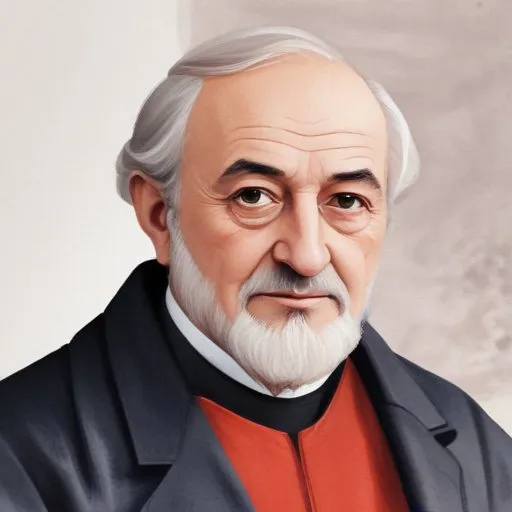
A 17th-century polymath who mapped Moldavia, wrote histories, and philosophized about the human condition. He's most known for his groundbreaking geographical and historical works on Eastern Europe.
Dimitrie Cantemir, also known as Demetrius Cantemir, was a Moldavian prince, statesman, and man of letters, renowned for his exceptional literary and philosophical contributions, as well as his remarkable diplomatic and political achievements. He twice served as voivode of Moldavia, and his legacy has left an indelible mark on the realms of history, philosophy, literature, and music.
Born on October 26, 1673, in Siliteni, Moldavia (now Vaslui County, Romania), Dimitrie was the son of Constantin Cantemir, a noble and learned man, and Ana Bant, a learned daughter of a local noble family. Despite his father's illiteracy, Constantin ensured that his sons, Dimitrie and Antioh, received a thorough education. Dimitrie learned Greek and Latin, reading the classics as a child, under the tutelage of scholars such as John Komnenos Molyvdos.
Between 1687 and 1710, Dimitrie spent most of his time as a hostage or envoy in Constantinople, where he honed his diplomatic skills and developed a deep understanding of the complexities of international politics. In 1693, he was appointed voivode of Moldavia for the first time, a position he held until 1710, when he was forced into exile following Russia's defeat in the war against the Ottoman Empire.
During his second term as voivode (1710-1711), Cantemir allied Moldavia with Russia, a decision that would have far-reaching consequences for his family and his state. Although the alliance ended in defeat, it marked the beginning of Cantemir's reputation as a shrewd diplomat and strategist.
Cantemir was a prolific writer, producing works that spanned a wide range of subjects, including philosophy, history, music, linguistics, ethnography, and geography. His philosophical contributions were particularly notable, as he engaged with the ideas of prominent thinkers such as René Descartes and Gottfried Wilhelm Leibniz.
One of his most famous works, Descrierea Moldovei (The Description of Moldavia), is a comprehensive historical and geographical treatise that showcases his mastery of multiple disciplines. His other notable works include Historia Hieroglyphica, a treatise on hieroglyphics, and Divanul, a collection of poems and essays.
Cantemir's legacy extends far beyond his literary and philosophical contributions. He played a significant role in shaping the cultural and political landscape of his time, and his diplomatic efforts helped lay the groundwork for future generations.
His son, Antioch, would go on to become a prominent figure in Russian literature, earning the title of "father of Russian poetry." Cantemir's influence can also be seen in the works of prominent Enlightenment thinkers, such as Montesquieu and Voltaire, who were acquainted with his son Antioch.
Dimitrie Cantemir's life and work were shaped by the complex geopolitical landscape of his time, marked by the struggle for power and influence between the Ottoman Empire, Russia, and other European nations. Despite the challenges he faced, Cantemir left an indelible mark on the world, his contributions continuing to inspire and educate generations to come.
