


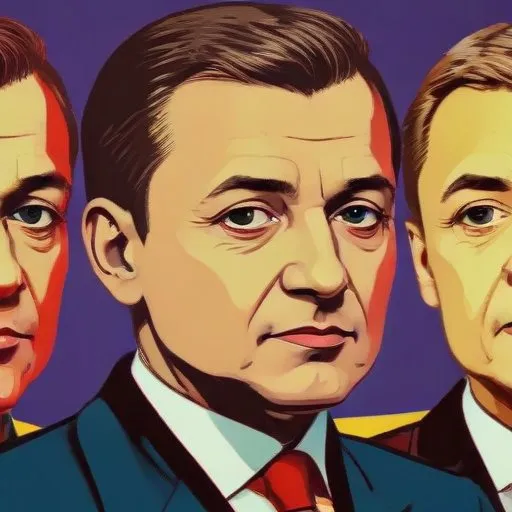
A Lithuanian-Ukrainian historian and politician who served as Ukraine's Minister of Foreign Affairs and Prime Minister, playing a significant role in shaping the country's early 20th-century politics. He's also known for his historical writings on Eastern Europe.
Dmytro Doroshenko is renowned as a prominent Ukrainian political figure, historian, and writer who advocated for federal ties with the Russian Republic during the revolution of 1917-1918. As a leading Ukrainian emigre historian during the interwar period, Doroshenko's work significantly contributed to Ukraine's national movement and identity.
Born on April 8, 1882, into an old Ukrainian Cossack noble family, Doroshenko was destined for greatness. His family had produced two prominent Hetmans during the 17th century, setting the stage for his future endeavors. Doroshenko pursued higher education at the universities of Warsaw, Saint Petersburg, and Kyiv, where he developed a passion for history and literature.
In the early 20th century, Doroshenko became an active contributor to Ukrainian periodicals, editing the political journal Ukrainskii vestnik (The Ukrainian Herald). This publication reflected the views of the Ukrainian Club in the Russian State Duma, solidifying his position as a voice for Ukrainian nationalism. His involvement with the Ukrainian Scientific Society in Kiev and the Prosvita educational society in Yekaterinoslav further cemented his reputation as a champion of Ukrainian culture and education.
Doroshenko's political career spanned several pivotal roles during the Ukrainian revolution. He initially held responsible positions within the Ukrainian Central Rada, a radical and socialist parliament, and played a key role in establishing the autonomous Ukrainian People's Republic. However, as the Central Rada shifted increasingly to the left, Doroshenko supported the conservative coup staged by General Pavlo Skoropadskyi and his German military supporters. He was subsequently appointed Foreign Minister in the newly established Hetmanate, where he fought to preserve the Ukrainian national element.
As a historian, Doroshenko's work focused on Ukraine's national identity and its relationships with neighboring nations. His publications provided a nuanced understanding of Ukraine's complex history, highlighting the country's struggle for independence and self-determination. His writing style, characterized by meticulous research and vivid descriptions, has been celebrated for its immersive quality and ability to transport readers to a bygone era.
Dmytro Doroshenko's legacy extends beyond his political and historical contributions. As a visionary, he paved the way for future generations of Ukrainian historians, politicians, and intellectuals. His commitment to federal ties with the Russian Republic and his advocacy for Ukrainian nationalism continue to influence contemporary Ukrainian politics and identity. As a testament to his enduring impact, Doroshenko's work remains a vital component of Ukraine's cultural heritage, inspiring future generations to strive for national unity and independence.
As a testament to his remarkable life and work, Dmytro Doroshenko's legacy continues to shape Ukraine's national identity and inspire future generations of historians, politicians, and intellectuals.
Born in 1880
Ukrainian playwright and politician who served as the 1st Prime Minister of the Ukrainian People's Republic, known for his literary works and role in Ukraine's struggle for independence.
Born in 1879
A Ukrainian journalist and politician who played a key role in Ukraine's struggle for independence after World War I, leading the Ukrainian People's Republic. He's infamous for his alleged involvement in pogroms against Jewish communities.
Born in 1873
German-Ukrainian general and politician who led Ukraine's struggle for independence during the Russian Civil War, establishing a short-lived Hetmanate government. He's known for his brief but significant reign and attempts to unify Ukraine.
