


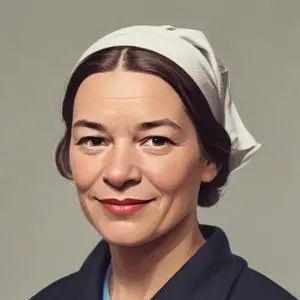
A pioneering social activist and journalist who advocated for pacifism, women's rights, and the poor, founding the Catholic Worker Movement to promote social justice and nonviolence.
Dorothy Day, a prominent American journalist, social activist, and anarchist, is best known for her unwavering commitment to social justice and her pioneering work in establishing the Catholic Worker Movement.
Born on November 8, 1897, in Brooklyn Heights, New York, Day grew up in a middle-class family with a strong sense of patriotism. Her early years were marked by a bohemian lifestyle, but it wasn't until her conversion to Catholicism in 1927 that she discovered her true calling.
Day's conversion story, as described in her 1952 autobiography, The Long Loneliness, serves as a testament to her journey towards faith in a secularized environment.
In the 1930s, Day, along with fellow activist Peter Maurin, co-founded the Catholic Worker Movement, a pacifist movement that combines direct aid for the poor and homeless with nonviolent direct action on their behalf.
As part of the movement, Day co-founded the Catholic Worker newspaper in 1933, serving as its editor until her death in 1980. The newspaper became a powerful platform for advocating the Catholic economic theory of distributism, a third way between capitalism and socialism.
Throughout her life, Day remained steadfast in her commitment to social justice, practicing civil disobedience and participating in nonviolent protests. This commitment led to her imprisonment in 1917 as a member of suffragist Alice Paul's nonviolent Silent Sentinels, as well as subsequent arrests in 1955, 1957, and 1973, at the age of 75.
Pope Benedict XVI praised Day's conversion story as an example of how to journey towards faith in a secularized environment. Pope Francis, in an address before the United States Congress, included Day in a list of four exemplary Americans who built a better future.
The Catholic Church has opened the cause for Day's possible canonization, referring to her as the "Servant of God."
"The Gospel takes away our right forever to discriminate between the deserving and the undeserving poor."
"We cannot build up the idea of the apostolate of the laity without the foundation of the apostolate of the priest."
Dorothy Day's unwavering commitment to social justice, her pioneering work in establishing the Catholic Worker Movement, and her inspirational life story have cemented her place as a beacon of hope and a champion of human dignity.
Born in 1915
A Trappist monk and writer who explored spirituality and social justice through his poetry and essays, leaving a lasting impact on Christian mysticism and contemplative thought.
Born in 1921
A Catholic priest who wrote poetry and protested war and nuclear proliferation through nonviolent civil disobedience, inspiring a generation of activists.
Born in 1923
A Catholic priest who protested the Vietnam War and nuclear proliferation through nonviolent civil disobedience, including burning draft files and hammering on nuclear warhead nose cones.
99 Years Old
Founded the United Farm Workers to improve working conditions and wages for farmworkers, leading boycotts and strikes to bring attention to their plight.
97 Years Old
A prominent leader in the civil rights movement, advocating for racial equality and social justice through nonviolent means, leaving a lasting impact on American history.
Born in 1910
A selfless Albanian-Indian nun dedicated her life to caring for the poor, sick, and marginalized, earning her a Nobel Peace Prize and sainthood. Her tireless charity work inspires millions worldwide.
