


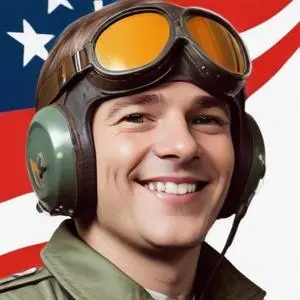
Notorious for flying from New York to Ireland in 1938, despite being denied permission, earning the nickname "Wrong Way" for his unauthorized transatlantic flight.
Douglas Corrigan, an American aviator, is notoriously known for his unauthorized transatlantic flight in 1938, earning him the nickname "Wrong Way Corrigan." On July 17, 1938, Corrigan took off from Floyd Bennett Field in Brooklyn, New York, claiming to be headed to Los Angeles, but instead landed in Dublin, Ireland, after a 28-hour flight.
Clyde Groce Corrigan, later renamed Douglas, was born on January 22, 1907, in Galveston, Texas. His father, a construction engineer, and mother, a teacher, divorced when Corrigan was young, and he eventually settled with his mother in Los Angeles. Corrigan quit high school before graduating and worked in construction before discovering his passion for aviation.
In October 1925, Corrigan paid $2.50 for a short ride in a Curtiss JN4 Jenny biplane near his home. This experience sparked his interest in flying, and he began taking lessons a week later. After completing 20 lessons, Corrigan made his first solo flight on March 25, 1926. He soon landed a job as an aircraft mechanic at the Ryan Aeronautical Company in San Diego, where he honed his skills and built a strong foundation in aviation.
Corrigan's modified 1929 Curtiss Robin aircraft, which he had prepared for a transatlantic flight, took off from Floyd Bennett Field on July 17, 1938. Filing a flight plan to return to Los Angeles, Corrigan claimed to have experienced a navigational error due to heavy cloud cover and low light conditions, which led him to misread his compass. Despite being a skilled aviator and mechanic, Corrigan's claim was met with skepticism, and many believed he had intentionally flown to Ireland to gain fame and recognition.
Corrigan's unauthorized flight sparked international controversy, and he was ultimately fined $1,000 and suspended from flying for 14 days. However, his feat also brought him fame and recognition, earning him the nickname "Wrong Way Corrigan." Corrigan never publicly admitted to having flown to Ireland intentionally, but his mysterious smile and cunning remarks only added to the public's fascination.
Corrigan's achievement was recognized with an honorary doctorate from the University of Maine, and he was also awarded the Harmon Trophy for his outstanding achievement in aviation.
Corrigan married and had three children, living a relatively private life after his transatlantic feat. He continued to work as an aircraft mechanic and consultant until his retirement. Douglas Corrigan passed away on December 9, 1995, at the age of 88, leaving behind a legacy of adventure and mystery.
Born in 1902
The first person to fly solo non-stop across the Atlantic Ocean, completing a historic 33.5-hour flight in 1927 and becoming an international hero and aviation icon.
Born in 1897
Pioneering female aviator who broke records and pushed boundaries in flight, mysteriously disappearing during a attempted circumnavigation of the globe.
Born in 1898
First pilot to fly solo around the world, and developed the first pressure suit, enabling high-altitude flights.
Born in 1905
A pioneer in aviation and film, known for pushing boundaries in both industries, and infamous for his eccentricities and reclusive nature.
Born in 1890
A Medal of Honor recipient and pioneering aviator, known for his heroic feats in World War I and his leadership in the aviation industry.
Born in 1896
Led a daring bombing raid on Tokyo in 1942, earning the Medal of Honor for his bravery and helping to turn the tide of World War II.
Born in 1923
The first test pilot to break the sound barrier, achieving a historic milestone in aviation and paving the way for supersonic flight. This daring feat cemented his status as a legendary figure in the history of flight.
