


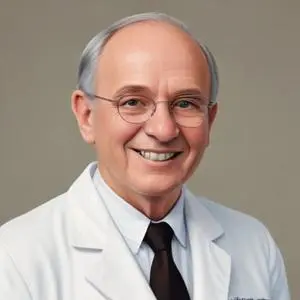
Pioneering transplant physician who developed bone marrow transplantation, revolutionizing leukemia treatment. He was awarded the Nobel Prize in Physiology or Medicine in 1990.
E. Donnall Thomas is renowned for his groundbreaking work in the development of cell and organ transplantation, earning him the Nobel Prize in Physiology or Medicine in 1990. Alongside Joseph E. Murray, Thomas's pioneering research paved the way for bone marrow transplantation as a viable treatment for leukemia.
Born on March 15, 1920, in Mart, Texas, Thomas was influenced by his father, a general practice doctor, and often shadowed him during his early years. He attended the University of Texas at Austin, where he studied chemistry and chemical engineering, graduating with a Bachelor of Arts in 1941 and a Master's degree in 1943. During his undergraduate years, Thomas met his future wife, Dorothy "Dottie" Martin, a journalism student.
Thomas entered Harvard Medical School in 1943, earning his Doctor of Medicine in 1946. Dottie, who became a lab technician, supported the family during this period and later collaborated with Thomas in his research endeavors. After completing his residency at Peter Bent Brigham Hospital, Thomas served two years in the United States Army as an internist stationed in Germany.
In 1955, Thomas was appointed physician-in-chief at Mary Imogene Bassett Hospital (now Bassett Medical Center) in Cooperstown, New York, an affiliate of Columbia University. It was during this period that he began to study bone marrow transplantation, laying the foundation for his future Nobel Prize-winning work.
Thomas's research focused on developing bone marrow transplantation as a treatment for leukemia. However, a series of experimental treatments for leukemia and graft-versus-host disease at Seattle's Fred Hutchinson Cancer Research Center from 1981 to 1993 was marred by controversy. Participants were not informed of the potential financial conflicts of interest held by Thomas and other researchers, and were not properly informed of the risks. Despite objections from the Center's Internal Review Board, the study continued, resulting in the death of 84 out of 85 participants.
In recognition of his pioneering work, Thomas received the Nobel Prize in Physiology or Medicine in 1990, alongside Joseph E. Murray. This prestigious award acknowledged their groundbreaking contributions to the field of organ and cell transplantation.
Thomas's partnership with his wife, Dottie, extended beyond their personal relationship to a professional collaboration that spanned several decades. Together, they had three children. Thomas passed away on October 20, 2012, leaving behind a legacy that continues to shape the field of medicine.
Thomas's work has had a profound impact on modern medicine, paving the way for life-saving bone marrow transplantations. His pioneering spirit and dedication to advancing medical knowledge have inspired generations of researchers and medical professionals.
46 Years Old
A British motorcycle road racer who won the 1999 British Superbike Championship and competed in the Superbike World Championship, earning him a reputation as a skilled and fearless rider.
65 Years Old
The first African American to hold the office, he served two terms as President of the United States, earning a Nobel Peace Prize for his efforts to strengthen international diplomacy and cooperation. He's known for his charismatic leadership and commitment to progressive values.
83 Years Old
The 46th President of the United States, currently serving as the leader of the country, known for his efforts in addressing climate change and promoting unity.
80 Years Old
The 42nd President of the United States, a charismatic leader who reformed healthcare and economy, and infamous for his scandals.
79 Years Old
A highly influential American politician and diplomat who served as Secretary of State and First Lady, known for her advocacy on women's rights and international diplomacy.
86 Years Old
The 52nd Speaker of the United States House of Representatives is a powerful politician who has played a crucial role in shaping the country's legislative agenda. They are known for their strong leadership and advocacy on issues like healthcare and women's rights.
93 Years Old
A pioneering Supreme Court Justice and women's rights advocate who championed gender equality and became a cultural icon.
96 Years Old
First female Supreme Court Justice in the United States, serving from 1981 to 2006 and playing a crucial role in many landmark cases, particularly those involving gender equality and reproductive rights.
