


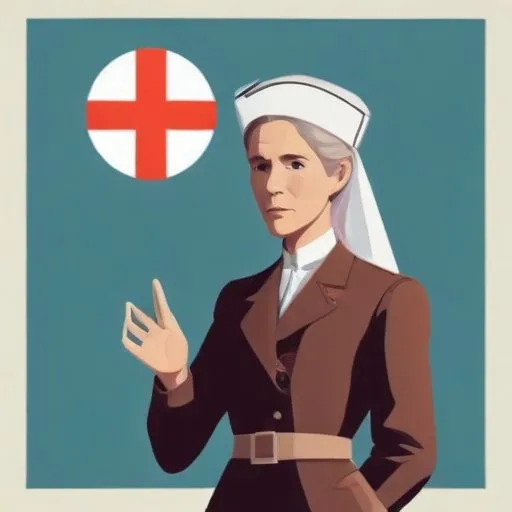
A British nurse who helped soldiers from both sides during WWI, and was executed by the Germans for treason, becoming a symbol of courage and compassion.
Edith Cavell was a British nurse who etched her name in the annals of history by treating wounded soldiers from both sides without discrimination during World War I, and for helping over 200 Allied soldiers escape from German-occupied Belgium. Her selfless acts of bravery and compassion in the face of adversity have made her a timeless symbol of humanity and courage.
Born on December 4, 1865, in Swardeston, a village near Norwich, England, Edith Cavell was the eldest of four children to Reverend Frederick Cavell and his wife Louisa Sophia Warming. Her early life was marked by a strong Anglican upbringing, which instilled in her a sense of duty to help those in need.
Cavell's journey into the world of nursing began when she cared for her ailing father, an experience that inspired her to pursue a career in nursing. She went on to work as a nurse in various institutions, including the Royal London Hospital, and later became the matron of a nursing school in Brussels, Belgium.
When World War I broke out, Cavell remained in Brussels, where she continued to care for wounded soldiers from both the Allied and Central Powers. Her hospital, the Clinique Sainte-Élisabeth, became a haven for soldiers of all nationalities, and Cavell's unwavering commitment to saving lives earned her the respect and admiration of all who knew her.
In addition to her humanitarian work, Cavell also helped facilitate the escape of over 200 Allied soldiers from German-occupied Belgium, working closely with a network of resistance fighters and sympathizers. Her bravery and selflessness, however, did not go unnoticed by the German authorities, who eventually arrested her in August 1915.
Cavell's court-martial was swift and merciless, with a German military court sentencing her to death by firing squad. Despite international pressure for mercy, including a plea from the American ambassador to Germany, Cavell's sentence was upheld, and she was executed on October 12, 1915.
Her final words, spoken on the eve of her execution, have become a testament to her unwavering humanity: "Patriotism is not enough. I must have no hatred or bitterness towards anyone." These words, inscribed on the Edith Cavell Memorial in London, continue to inspire generations to strive for compassion, tolerance, and understanding.
Edith Cavell's sacrifice and bravery have left an indelible mark on history. The Church of England commemorates her as a martyr and heroine, and her feast day is celebrated on October 12.
Edith Cavell's story is a powerful reminder of the transformative power of compassion, courage, and humanity in the face of adversity. As we navigate the complexities of our modern world, her legacy serves as a beacon of inspiration, urging us to strive for a world where love, kindness, and understanding prevail.
Born in 1820
Pioneering nurse and statistician who revolutionized healthcare by introducing sanitation practices and data-driven decision making, becoming the founder of modern nursing.
Born in 1821
Founded the American Red Cross, providing humanitarian aid and disaster relief, and pioneering nursing education. Known for her courageous and selfless efforts during the Civil War and beyond.
Born in 1910
African-American mathematician and NASA employee who played a crucial role in the early years of the space program, breaking racial and gender barriers along the way.
Born in 1884
A humanitarian and politician who championed human rights, women's empowerment, and social justice, leaving a lasting impact on American politics and international relations.
Born in 1910
A selfless Albanian-Indian nun dedicated her life to caring for the poor, sick, and marginalized, earning her a Nobel Peace Prize and sainthood. Her tireless charity work inspires millions worldwide.
