


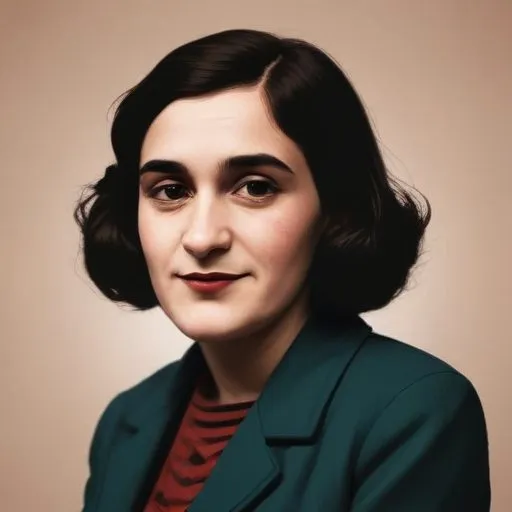
The mother of a young Jewish girl who wrote a heart-wrenching diary during WWII, hiding with her family from the Nazis, which became a famous book after the war. She played a crucial role in preserving her daughter's diary and promoting its publication.
Edith Frank, née Holländer, is forever etched in history as the mother of Anne Frank, the young diarist who chronicled the brutal realities of the Holocaust. Edith's selflessness, love, and devotion to her family, particularly her daughters, have become a beacon of hope and humanity amidst one of humanity's darkest periods.
Born on January 16, 1900, in Aachen, Germany, Edith was the youngest of four children to Abraham and Rosa Holländer. Her father, a successful businessman, was an active member of the Aachen Jewish community. Edith's family adhered to Jewish dietary laws and was considered religious, yet she attended the Evangelical Higher Girls School and passed her school-leaving exams (Abitur) in 1916.
In her free time, Edith was an avid reader, enjoyed tennis, swimming, and had a large circle of friends. Her older sister, Bettina, passed away at the age of 16 from appendicitis, leaving Edith and her two older brothers, Julius and Walter, who would later immigrate to the United States.
In 1924, Edith met Otto Frank, and they married on his 36th birthday, May 12, 1925, at Aachen's synagogue. The couple had two daughters, Margot, born on February 16, 1926, and Anne, born on June 12, 1929, in Frankfurt.
The Frank family lived in a house at Marbachweg 307 in Frankfurt-Dornbusch, where they rented two floors. Edith's daughters played daily with the children in the neighborhood, from diverse backgrounds such as Catholic, Protestant, or Jewish.
As the Nazi occupation of the Netherlands intensified, Edith, Otto, Margot, and Anne went into hiding in Amsterdam in 1942. They shared a secret annex with four others, including Fritz Pfeffer, who would later become a close friend and confidant to Anne.
During their hiding, Edith continued to nurture her daughters' love for learning, encouraging them to maintain their diaries and pursue their interests. Her selflessness and maternal instincts helped sustain the family's spirits amidst the uncertainty and fear.
On August 4, 1944, the Nazis discovered the secret annex, and Edith, along with her family, was arrested and deported to Auschwitz-Birkenau concentration camp. Edith was separated from her daughters and sent to the women's section, where she faced unspeakable hardships.
Tragically, Edith passed away on January 6, 1945, just a few weeks before the liberation of Auschwitz. Her daughters, Margot and Anne, also perished in the concentration camps, with Anne's diary becoming a testament to the horrors of the Holocaust and a symbol of hope for humanity.
Edith Frank's unwavering devotion to her family, particularly her daughters, has inspired generations. Her story serves as a powerful reminder of the human spirit's capacity for love, resilience, and sacrifice in the face of unimaginable adversity.
Through her daughter Anne's diary, Edith's legacy continues to educate, inspire, and warn against the dangers of hatred, intolerance, and bigotry. Her story is a testament to the indomitable power of motherly love and the importance of preserving humanity in the darkest of times.
97 Years Old
A young Jewish girl who documented her experiences hiding with her family during the Nazi occupation in a diary, which became a powerful and enduring symbol of hope and resilience. Her diary has been translated into over 60 languages and has sold millions of copies worldwide.
Born in 1889
The father of a young Jewish girl who wrote a heart-wrenching diary during WWII, hiding from the Nazis, and later dedicated his life to spreading her message of hope and peace. He established a museum and foundation in her honor, keeping her legacy alive.
Born in 1909
A brave and selfless individual who risked their life to hide a Jewish family, including a young girl who would become a symbol of hope and resilience, from the Nazis during WWII. This hero's actions allowed the family to survive for two years, and their story to be told.
Born in 1905
A Dutch resistance worker who helped hide and protect Jews, including Anne Frank and her family, during World War II.
