


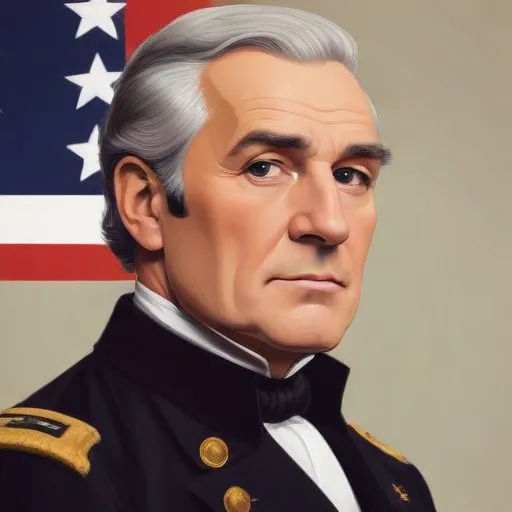
American captain and politician who served as the 39th Governor of South Carolina, playing a key role in the American Revolutionary War and later advocating for states' rights.
Edward Rutledge, a prominent American Founding Father and politician, is known for being the youngest signatory of the Declaration of Independence and serving as the 39th governor of South Carolina. Born on November 23, 1749, in Charleston, South Carolina, Rutledge played a significant role in shaping the country's early years.
Rutledge was the youngest of seven children born to Dr. John Rutledge and Sarah Hext. His father, a physician and colonist of Scots-Irish descent, and his mother, of English descent, instilled in him a strong sense of education and values. Following in the footsteps of his elder brothers, John and Hugh, Rutledge studied law in London at the Inns of Court.
In 1772, he was admitted to the English bar at Middle Temple and returned to Charleston to practice law. His successful law practice, partnered with Charles Cotesworth Pinckney, propelled him to become a leading citizen of Charleston.
Rutledge married Henrietta Middleton, daughter of Henry Middleton, on March 1, 1774. The couple had three children: Major Henry Middleton Rutledge, Edward Rutledge, and Sarah Rutledge. Rutledge's family life was marked by tragedy, with his wife passing away on April 22, 1792.
During the American Revolution, Rutledge served alongside his brother John, representing South Carolina in the Continental Congress from 1774 to 1776. Despite being a firm supporter of colonial rights, he was initially instructed to oppose Richard Henry Lee's Resolution of independence, as South Carolina's leaders were unsure if the time was ripe.
However, Rutledge soon became a strong advocate for independence, and at the age of 26, he became the youngest delegate to sign the Declaration of Independence. He returned home in November 1776 to take a seat in the General Assembly and served as a captain of artillery in the South Carolina militia, fighting at the Battle of Sullivan's Island.
Rutledge's legacy is marked by his commitment to colonial rights and his contribution to the Declaration of Independence. He served as the 39th governor of South Carolina, from 1789 to 1792, and worked to establish the state's government structure.
Despite his achievements, Rutledge's legacy is also marked by controversy. He owned more than 50 enslaved people and worked to have African Americans expelled from the Continental Army. However, his contributions to the country's early years cannot be overlooked.
"The greatest glory in living lies not in never falling, but in rising every time we fall." - Edward Rutledge
Rutledge's legacy continues to influence modern society. His commitment to colonial rights and his contribution to the Declaration of Independence have inspired generations of Americans. His story serves as a reminder of the complexities of American history and the importance of acknowledging both the achievements and the controversies of our founding fathers.
Edward Rutledge's life and legacy are a testament to the complexities of American history. His story serves as a reminder of the importance of acknowledging both the achievements and the controversies of our founding fathers, and his contribution to the Declaration of Independence continues to inspire generations of Americans.
79 Years Old
A Pulitzer Prize-winning composer, known for blending minimalism with complex rhythms, creating a unique sound that resonates with audiences worldwide.
Born in 1743
The principal author of the Declaration of Independence and a strong advocate for individual liberties and limited government, shaping America's foundational principles. He oversaw the Louisiana Purchase, doubling the country's territory.
Born in 1732
The first President of the United States, a military hero who led the country to independence, and set the standard for the office of the presidency. He's known for his honesty, integrity, and leadership skills.
Born in 1706
A founding father of the United States, he was a leading figure in the Enlightenment, known for his groundbreaking inventions, scientific discoveries, and influential writings. He played a key role in shaping American history and politics.
Born in 1736
A pioneering figure in American history, he played a key role in the American Revolution and is famous for declaring "Give me liberty or give me death!" in a speech that helped galvanize the colonial resistance against British rule.
Born in 1737
First Governor of Massachusetts, instrumental in American independence and famously signed the Declaration of Independence with a large, bold signature .
Born in 1722
A leading figure in the American Revolution, he played a key role in shaping the country's independence and democracy. He's also famous for his Boston Beer Company, which still brews his namesake beer today.
Born in 1735
This American patriot and artisan is famous for his midnight ride during the American Revolution, warning colonists that the British were coming, and for his iconic engravings, including the Boston Massacre depiction.
