


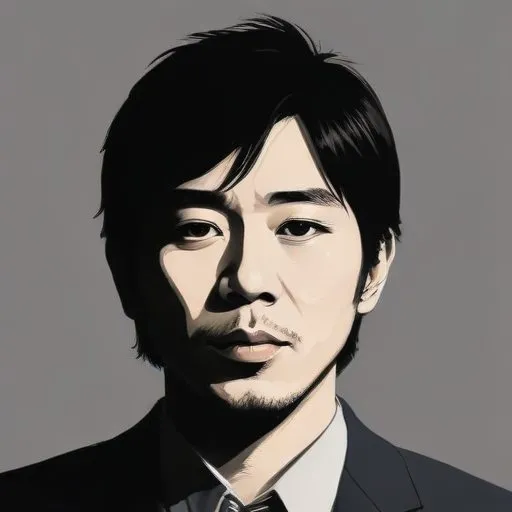
A renowned Japanese musician and producer, known for his eclectic and influential work in the city pop genre, blending jazz, funk, and rock elements. He's behind numerous iconic albums and soundtracks, shaping Japan's music landscape.
Eiichi Ohtaki, a legendary Japanese musician, singer-songwriter, and record producer, left an indelible mark on the music industry with his unique fusion of pop, rock, and folk elements. As a member of the iconic rock band Happy End and a successful solo artist, Ohtaki's contributions have been hailed as an encyclopedia of everything great about pop music in the 20th century.
Ohtaki was born on July 28, 1948, in Esashi District, Hokkaido, Japan. Before joining Happy End, Ohtaki was the guitarist in a group called Taboo with future Blues Creation singer Fumio Nunoya. Happy End produced three albums - Happy End (1970), Kazemachi Roman (1971), and Happy End (1973) - before officially disbanding on New Year's Eve, 1972.
In November 1972, Ohtaki released his debut solo album, Eiichi Ohtaki, which was met with critical acclaim. Macias described it as "probably just what Happy End fans expected - tuneful folk-rock and fuzzed-out country-rock nuggets à la Neil Young." However, this marked a departure from Ohtaki's subsequent work, which would take on a more experimental and innovative approach.
In 1975, Ohtaki founded Niagara Records, a label that would go on to release music by Sugar Babe, a rock band he produced. The band's only album, Songs, was the first release on Niagara Records, followed by Ohtaki's second album, Niagara Moon, a month later.
In 1976, Ohtaki, Tatsuro Yamashita, and Ginji Ito (briefly of Sugar Babe) released Niagara Triangle Vol. 1, a collaborative album that showcased the trio's creative synergy. This project was cited by MTV as one of the six Japanese supergroups that changed the music landscape.
In 2003, Ohtaki was ranked by HMV Japan at number 9 on their list of the 100 most important Japanese pop acts. His influence can be seen in the work of numerous Japanese musicians, including Tatsuro Yamashita and Haruomi Hosono, who have credited Ohtaki as a major inspiration.
Ohtaki's legacy extends beyond his music, too. He was known for his perfectionism and attention to detail, which rubbed off on the artists he worked with. His studio, Niagara Studio, became a hub for Japanese musicians to experiment and innovate.
Ohtaki passed away on December 30, 2013, leaving behind a rich legacy of music and inspiration. Interestingly, Ohtaki was known for his love of cars and owned several vintage models, including a 1967 Chevrolet Corvette.
Despite his untimely passing, Ohtaki's music continues to inspire new generations of musicians and fans alike. His innovative approach to music production and his contributions to Japanese pop culture have cemented his place as one of the most important figures in Japanese music history.
79 Years Old
A Japanese music icon, known for blending folk, rock, and electronic elements to create a unique sound, and producing influential albums that shaped the country's music scene.
74 Years Old
A visionary musician who blends electronic and acoustic elements to create hauntingly beautiful soundscapes, scoring iconic films like "Merry Christmas, Mr. Lawrence" and "The Last Emperor".
60 Years Old
A renowned Japanese ballerina celebrated for her technical precision and lyrical style, particularly in classical ballets like Swan Lake and Giselle. She was a principal dancer with the Royal Ballet and American Ballet Theatre.
