


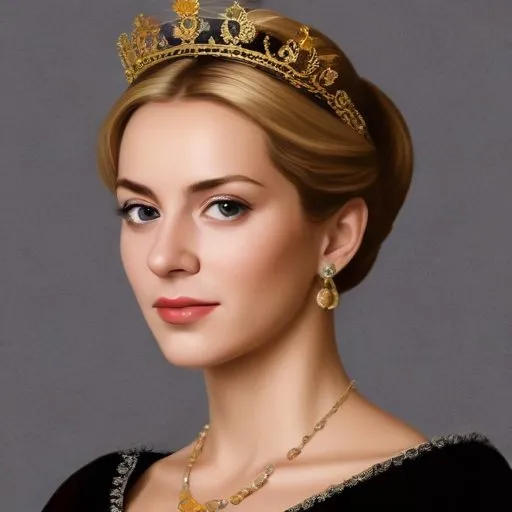
The Queen of Spain who masterminded a series of strategic marriages and military campaigns to secure her family's power and reclaim lost territories, becoming one of the most influential women in European history. She is also known for her patronage of the arts and architecture, leaving a lasting legacy in Spanish culture.
As the Queen of Spain by marriage to King Philip V, Elisabeth Farnese ruled the country with an iron fist from 1714 to 1746, earning her the reputation as one of the most influential queens in Spanish history. Her shrewd diplomatic skills and clever political maneuvering allowed her to manage the affairs of state with the approval of her spouse, making her the de facto ruler of Spain.
Born on October 25, 1692, at the Palazzo della Pilotta in Parma, Italy, Elisabeth was the daughter of Odoardo Farnese and Dorothea Sophie of Neuburg. She was raised in seclusion in the Palace, where she received a comprehensive education in languages, including Latin, French, and German, as well as rhetoric, philosophy, geography, and history. Although she showed little interest in her studies, Elisabeth developed a passion for dance, painting, and music.
Due to the lack of male heirs in her family, Elisabeth was groomed for succession to the Duchy of Parma through the female line. She received numerous marriage proposals, including from Victor Amadeus, Prince of Piedmont, and Francesco d'Este, Hereditary Prince of Modena. However, it was her marriage to Philip V of Spain on September 16, 1714, that catapulted her to the throne.
During her reign, Elisabeth played a crucial role in shaping Spain's foreign policy, often to the benefit of her native Parma. She skillfully navigated the complex web of European alliances, securing key victories and expanding Spain's territories. Her diplomatic prowess was instrumental in the Treaty of Vienna (1725) and the Treaty of Seville (1729), which solidified Spain's position as a major European power.
Elisabeth's influence extended beyond politics to the realm of art and architecture. She was a patron of the arts, commissioning works from prominent artists and architects of the time. Her love for music and dance led to the establishment of the Spanish royal opera house, which became a hub for cultural innovation.
Elisabeth's marriage to Philip V produced seven children, including three sons who would go on to play significant roles in European history: Infante Carlos, Infante Felipe, and Infante Luis. Her children's marriages and alliances further solidified her family's hold on power, with the House of Bourbon-Parma still reigning today.
Elisabeth Farnese's remarkable reign left an indelible mark on Spanish and European history. Her shrewd political acumen, cultural patronage, and family alliances cemented her position as one of the most influential queens of her time. Today, she remains an iconic figure, remembered for her intelligence, determination, and unwavering dedication to her country and family.
Elisabeth Farnese's remarkable life serves as a testament to the power of intelligence, determination, and strategic thinking. Her enduring legacy continues to inspire generations, making her one of the most fascinating and influential figures in European history.
Born in 1716
The Enlightened Despot who reformed Spain, promoting education, arts, and economic growth, and is credited with modernizing Madrid.
Born in 1710
The monarch who ruled France from 1715 to 1774, known as the "Sun King's" great-grandson, and remembered for his extravagance, absolutism, and the decline of the French monarchy.
Born in 1666
King of Sardinia from 1720 to 1730, he played a crucial role in the War of the Spanish Succession and was eventually crowned King of Sicily. He's known for his military campaigns and territorial expansions.
Born in 1667
The queen consort of Spain from 1689 to 1700, known for her strong personality and influential role in Spanish politics during her husband's reign. She played a key role in promoting the arts and culture in Spain.
Born in 1713
King of Spain from 1746 to 1759, known for his cultural and economic reforms, and for being the first Spanish monarch to visit Catalonia in over a century.
