


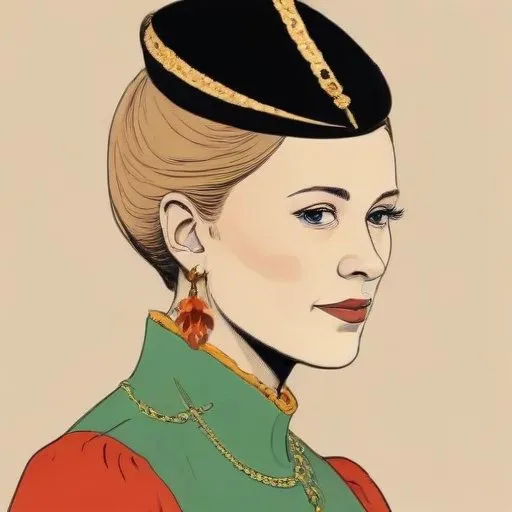
A German princess who married into the Saxon royal family and was a patron of the arts, particularly music and literature. She was also a strong advocate for women's education and social welfare.
Elisabeth of Hesse, also known as Elisabeth of Rochlitz, was a Hereditary Princess of Saxony who left an indelible mark on the Protestant Reformation movement in the 16th century. Through her marriage to John of Saxony and her subsequent management of her Wittum estates, she played a crucial role in spreading Protestantism throughout her territories, earning her a revered place in history.
Born on March 4, 1502, Elisabeth was the daughter of William II of Hesse and Anna of Mecklenburg-Schwerin. Her childhood was marked by the power struggles between her mother and the Hessian nobility, which led to her father's death in 1509. Following his demise, a five-member council, led by Ludwig von Boyneburg of Lengsfeld, took over the government on behalf of Elisabeth's brother, Philip I, and placed her and her mother under guardianship.
During this period, Elisabeth lived with her mother in Gießen, while her brother remained in Kassel under the supervision of Ludwig von Boyneburg. The council's control over their lives was evident in their financial dependence, which was accentuated in 1512. Their mother's attempts to present Elisabeth at the Saxon court were thwarted due to the council's refusal to provide the necessary funds.
In 1514, Anna regained the regency of Hesse, and Elisabeth's bertrothal contract with John, the eldest son of George Duke of Saxony, was finalized on March 8, 1515. This union would eventually lead to Elisabeth becoming the Hereditary Princess of Saxony.
After her husband John's death in 1537, Elisabeth took charge of her Wittum estates, comprising the Saxon districts of Rochlitz and Kriebstein. She managed these territories with determination, earning her the nickname Elisabeth of Rochlitz. During this period, she played a vital role in allowing the spread of Protestantism in her territories, making her a beacon of hope for the Lutheran movement.
Elisabeth's influence extended beyond her estates as she acted as a mediator between her Catholic mother and Lutheran brother. She also played a nurturing role as the nurse of Maurice of Saxony. Her diplomatic efforts helped bridge the gap between the warring factions, showcasing her remarkable ability to navigate complex relationships.
Elisabeth of Hesse's unwavering commitment to Protestantism paved the way for its widespread acceptance in Saxony. Her efforts as a mediator and matriarch also helped to bring about a temporary sense of unity in her family and beyond. As a testament to her enduring legacy, she remains an iconic figure in the history of the Protestant Reformation.
Born in 1762
The extravagant and flamboyant King of the United Kingdom, known for his lavish lifestyle, extravagant fashion sense, and architectural projects, including the transformation of Buckingham Palace. He played a significant role in the development of Regency London.
Born in 1867
The queen consort of the United Kingdom, married to King George V, known for her strong support of her husband and the British monarchy during World War I and the subsequent years of change. She was a popular figure, earning the respect and admiration of the British people.
Born in 1872
The first king of Norway after the country's independence from Sweden, he played a crucial role in maintaining Norway's sovereignty during World War II. He's revered for his bravery and leadership during the war.
Born in 1869
The youngest daughter of King Edward VII and Queen Alexandra, she was a fashion icon and trendsetter, known for her extravagant lifestyle and lavish parties.
