


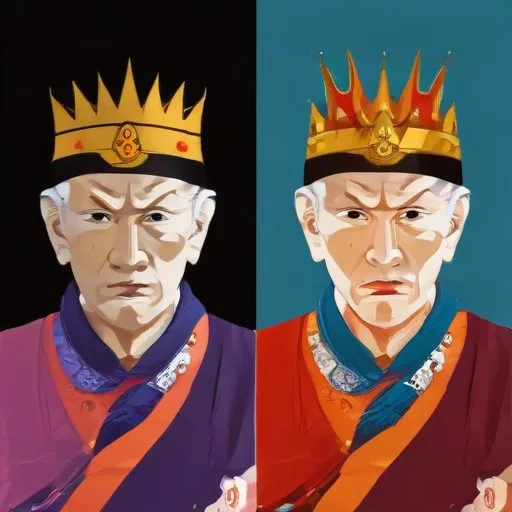
The 14th-century Japanese emperor who reigned during a period of civil war and is remembered for his attempts to reform the imperial system and restore power to the throne. He's also known for his cultural achievements, particularly in poetry and calligraphy.
Emperor GoKgon, also known as the Later Emperor Kgon, was the fourth emperor of the Northern Court during the Period of the Northern and Southern Courts, reigning from 1352 to 1371. He is remembered for his significant role in shaping the country's history during a tumultuous period.
Emperor GoKgon was born on March 23, 1338, as Iyahito, the second son of the Northern Pretender Emperor Kgon. His mother was Hideko, the daughter of Sanjô Kinhide and Lady-in-waiting Hirohashi Fujiwara Nakako.
Emperor GoKgon's reign marked a significant turning point in the Northern Court's history. During his rule, he worked to strengthen the court's position and restore its power. One of his notable achievements was the re-establishment of the Imperial Court's authority, which had been weakened by internal conflicts and external threats.
Emperor GoKgon had multiple consorts and children. His consorts included Uemon-no-Suke no Tsubone, Sakyôdaibu no Tsubone, and Shônagon-naishi. He had numerous children, including Imperial Prince Ohito, who later became Emperor Go-En, and several other imperial princes and princesses who went on to become prominent figures in Japanese history.
Emperor GoKgon's legacy is complex and multifaceted. While his reign was marked by significant challenges and conflicts, he played a crucial role in stabilizing the Northern Court and laying the groundwork for its future development. Today, he is remembered as an important figure in Japanese history, whose contributions continue to shape the country's cultural and political landscape.
Emperor GoKgon's reign coincided with a period of great turmoil in Japanese history, marked by the rivalry between the Northern and Southern Courts. In contrast to his contemporaries, Emperor Go-Kogon's focus on stabilizing the Northern Court and restoring its authority set him apart as a pragmatic and effective leader.
Emperor GoKgon's life and reign continue to fascinate historians and scholars today. His significant contributions to Japanese history, combined with his complex and multifaceted personality, make him a compelling figure worth further exploration and study.
Born in 1288
The 93rd emperor of Japan, ruling from 1298 to 1301, known for his brief but significant reign that marked the beginning of the Northern Court, a period of divided imperial courts in Japan.
Born in 1334
The 61st emperor of Japan, ruling from 1331 to 1333, known for his brief reign during a tumultuous period in Japanese history, marked by civil war and imperial court struggles.
