


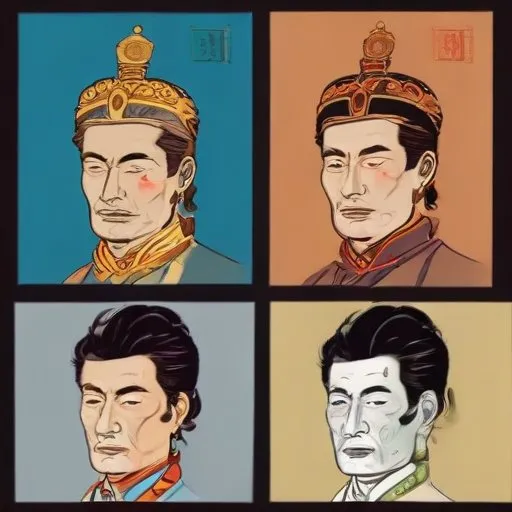
The ruler of the Western Xia dynasty, known for his military campaigns and territorial expansions, particularly the conquest of the Liao dynasty. He's also remembered for his cultural achievements, including the development of the Western Xia script.
Emperor Jingzong of Western Xia, also known as Li Yuanhao, is renowned for being the founder of the Western Xia dynasty of China, which he ruled from 1038 to 1048. During his reign, he successfully established a strong and independent Tangut state, earning him a prominent place in Chinese history.
Born in 1004, Emperor Jingzong was the eldest son of Li Deming, the Tangut ruler. His mother, Lady Weimu, was a consort of Tuoba Weiming. After his father's death in 1032, Jingzong became the leader of the Tangut people and worked tirelessly to establish an independent state for his people.
Jingzong is remembered for his exceptional military prowess, which enabled him to expand the Tangut empire and secure key territories. In 1034, he attacked the Huanqing territories and captured Song general Qi Zongju. He then turned his attention to the Kingdom of Qocho in the west, launching a campaign against them in 1036. His military successes allowed him to claim control over large portions of Gansu and the Hexi Corridor, which would remain under Tangut control for nearly two centuries.
In 1038, Jingzong declared himself the emperor of the Western Xia dynasty, establishing its capital in Xingqing. This marked the beginning of a new era for the Tangut people, who finally had a state to call their own. Jingzong's declaration of independence was a significant milestone, as it signaled the Tangut people's break from the Song dynasty and their determination to forge their own path.
Jingzong is also notable for the reforms he introduced to modernize and centralize the Tangut state. He abolished the surname Zhao, which had been imposed by the Song dynasty, and replaced it with the surname Weiming. He also enforced a new dress code and introduced a new writing system, which helped to distinguish the Tangut people from their Chinese and other neighboring ethnic groups.
Emperor Jingzong's legacy is one of strength, determination, and vision. He successfully established a powerful and independent state, which would endure for centuries. His military campaigns and reforms helped to shape the Tangut identity and created a sense of unity and purpose among his people. Today, he is remembered as a hero and a symbol of Tangut pride, whose achievements continue to inspire generations to come.
Despite his impressive achievements, Jingzong's life remains somewhat shrouded in mystery. However, his impact on Chinese history is undeniable, and his legacy continues to inspire and fascinate scholars and historians to this day.
