


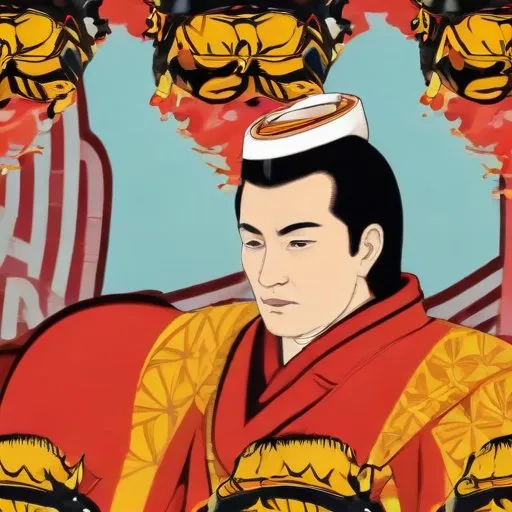
The 45th emperor of Japan, who reigned from 1336 to 1348, is most known for his role in the Northern Court during the Nanboku-ch? period, a time of civil war and imperial division. He's also remembered for his efforts to restore imperial authority and unify the country.
Emperor Kmy, also known as Yutahito, is renowned for being the second emperor of Japan's Northern Court, marking the beginning of a tumultuous era in Japanese history. His reign, spanning from 1336 to 1348, was marked by controversy, power struggles, and ultimately, abdication.
Born on January 11, 1322, Emperor Kmy was the second son of Emperor Go-Fushimi and Neishi, daughter of Saionji Kinhira. His royal lineage and family connections made him an integral part of Japan's imperial dynamics.
In 1336, Ashikaga Takauji, a powerful warlord, rebelled against Emperor Go-Daigo's Kenmu Restoration, leading to the occupation of Kyoto. Amidst the chaos, Prince Yutahito was enthroned as emperor, initiating the Northern Court. This move was met with resistance from the Southern Court, led by Emperor Go-Daigo, who fled to Yoshino.
The years that followed were marked by intense power struggles between the Northern and Southern Courts. In 1348, Emperor Kmy abdicated in favor of his nephew, Emperor Suk, son of his older brother. However, this decision did little to quell the conflict. In 1352, the Southern Emperor, Go-Murakami, seized Kyoto, capturing Emperor Kmy and other members of the Northern Court. They were eventually placed under house arrest in Yamato Province.
In 1355, Emperor Kmy returned to Kyoto and entered a monastery. He passed away on July 26, 1380, at the age of 60. Despite the tumultuous nature of his reign, Emperor Kmy's legacy is significant, as it highlights the complexities of Japan's medieval period and the struggle for imperial legitimacy.
Emperor Kmy's reign was marked by a series of eras, each reflecting the shifting sands of power and influence in Japan during this period.
Emperor Kmy's life and reign are a testament to the complexities of Japan's medieval period. His story is intertwined with the rise of the Ashikaga shogunate, the struggle for imperial legitimacy, and the factionalism that characterized this era. As such, he remains an important figure in Japanese history, offering valuable insights into the nation's formative years.
In conclusion, Emperor Kmy's life and reign were marked by tumult, power struggles, and ultimately, abdication. Despite the challenges he faced, his legacy remains significant, providing a unique window into Japan's medieval period and the intricacies of imperial politics.
