


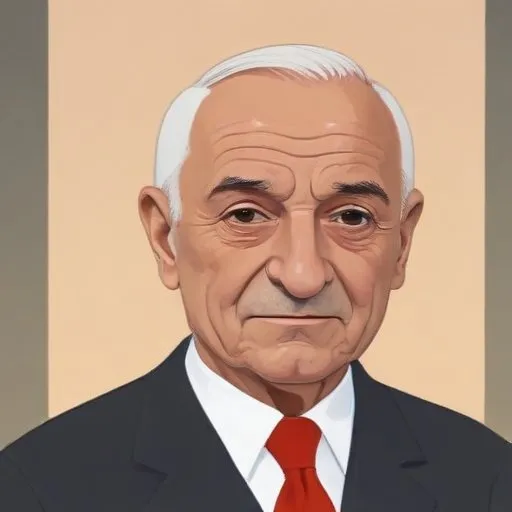
A Hungarian-French painter and illustrator known for his dreamlike, surreal works that blended fantasy and reality, often featuring distorted forms and vibrant colors. His art explored the subconscious and the world of dreams.
Endre Rozsda, a Hungarian-French painter, is renowned for his unique surrealist style, which weaves together memories, light, and fantasy to create vibrant, multicolored worlds. Born on November 18, 1913, in Mohács, Hungary, Rozsda's artistic journey is a testament to the power of imagination and creative expression.
Rozsda's childhood memories played a significant role in shaping his artistic vision. He drew inspiration from his idyllic surroundings in Mohács, where the Danube River flowed gently through the heart of the city. His early years instilled in him a deep appreciation for the relationship between memory, time, and creativity.
Rozsda rejected his family's plans for a career and chose to pursue painting at a young age. He honed his skills under Vilmos Aba-Novák's guidance, and by 23, he had already held his first solo exhibition at the Tams gallery in 1936. Critics raved about his work, and the Museum of Fine Arts, Budapest, acquired one of his paintings.
In the early years, Rozsda's style was closely tied to Hungarian postimpressionism. However, after attending a Béla Bartók concert, he came to a realization: "I am not my own contemporary." This epiphany marked a significant shift in his artistic approach, as he began to explore new avenues of expression.
In 1938, Rozsda moved to Paris, where he continued his studies at the École de Louvre. He befriended prominent artists like Árpád Szenes, Vieira da Silva, and Françoise Gilot, who would later become Picasso's companion. This new environment and the influences of his contemporaries further shaped his unique surrealist style.
Rozsda's artistic philosophy was deeply rooted in his experiences and emotions. He once said, "Out of memory and light, I weave a dense fabric. I look steadily at it until it comes to life and stares back at me, until it rises up in front of me." This quote encapsulates his creative process, which sought to capture the essence of time and memories.
Rozsda's artistic career spanned several decades, during which he created numerous remarkable works. Some of his notable paintings include "Old Women and Beggars," which showcased his ability to weave fog and light into melodic chimeras, and "Time and Memories," a testament to his fascination with the relationship between time and human experience.
Endre Rozsda's contributions to the world of surrealism are undeniable. His unique style, which blended memories, light, and fantasy, continues to inspire artists and art enthusiasts alike. His legacy serves as a reminder of the power of creativity and imagination to transcend time and space.
Rozsda passed away on September 16, 1999, in Paris, leaving behind a rich artistic heritage that continues to captivate audiences worldwide.
Endre Rozsda's life and art serve as a testament to the power of creativity and imagination. His unique surrealist style continues to inspire generations of artists, and his legacy remains an integral part of the art world's rich tapestry.
Born in 1896
French poet and author who founded Surrealism, a cultural movement that explored the subconscious and the world of dreams. He wrote novels, poems, and essays that continue to influence art and literature today.
Born in 1904
A renowned surrealist master of bizarre, dream-like paintings and sculptures that blur reality and fantasy, known for iconic works like "The Persistence of Memory" and "The Elephants".
Born in 1898
A Belgian surrealist painter who challenged perceptions by depicting everyday objects in unexpected contexts, creating thought-provoking and witty visual paradoxes.
Born in 1891
A pioneering figure in Surrealism, creating dreamlike, fantastical works that blurred reality and the subconscious, influencing generations of artists.
Born in 1893
A renowned Spanish artist, famous for his vibrant, dreamlike paintings and sculptures that blended abstraction and surrealism, creating a unique visual language. His works often featured bold colors, biomorphic forms, and a sense of playfulness.
Born in 1881
A pioneering artist who transformed modern art with pioneering Cubist works, creating a new visual language that continues to inspire and influence art, design, and culture.
Born in 1880
A pioneer of Fauvism, a style characterized by vivid colors and energetic brushstrokes, creating a new language of art that paved the way for modernist movements.
Born in 1869
A pioneering artist who revolutionized modern art with bold, expressive, and colorful works that blurred the lines between painting and sculpture, creating a new language of form and color.
