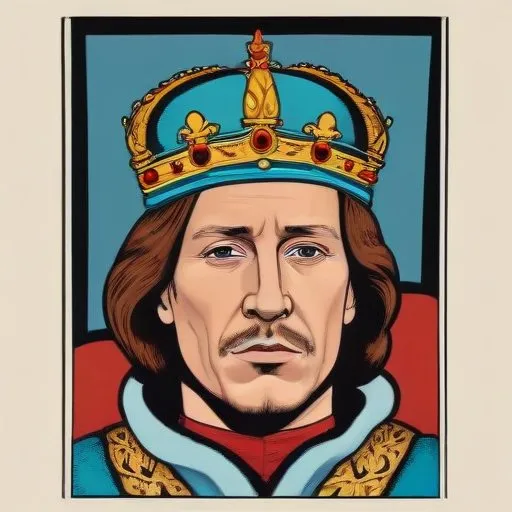
Eric XIV of Sweden: The Turbulent Reign of a Brilliant but Troubled King
A King of Contrasts
Eric XIV, King of Sweden from 1560 to 1568, is known for his remarkable intelligence, artistic talent, and political ambition, yet his reign was marked by mental instability and ultimately, tragic downfall. As the eldest son of Gustav I and Catherine of Saxe-Lauenburg, Eric XIV inherited a rich legacy, but his own life was a complex tapestry of brilliance and chaos.
Early Years and Education
Born on December 13, 1533, at Tre Kronor Castle, Eric XIV lost his mother before the age of two. His father, Gustav Vasa, remarried Margaret Leijonhufvud, a Swedish noblewoman, in 1536. Eric's early education was entrusted to the learned German Georg Norman, who was later replaced by French Calvinist Dionysius Beurraeus. Under Dionysius' tutelage, Eric excelled in foreign languages, mathematics, and history, demonstrating a particular affinity for astrology.
Rise to Power and Early Reign
In 1557, Eric was assigned the fiefdoms of Kalmar, Kronoberg, and Öland. He took up residence in Kalmar, where he began to assert his independence from his father's rule. Following Gustav Vasa's death in 1560, Eric ascended to the throne, earning the title of Hereditary King (Arvkonung) of Sweden. His early reign was marked by a series of bold reforms, including the establishment of a new parliament and the promotion of trade and commerce.
Mental Instability and the Sture Murders
However, Eric's reign was soon marred by signs of mental instability, which some scholars believe began as early as 1565. His behavior became increasingly erratic, culminating in the infamous Sture Murders of 1567, in which several prominent nobles, including three members of the Sture family, were brutally slaughtered on Eric's orders.
Deposition and Imprisonment
As Eric's mental state deteriorated, his brother John led a rebellion against him, capturing him in 1568. Eric was formally deposed on January 26, 1569, and imprisoned in various castles throughout Sweden.
The Mysterious Death of a King
Eric XIV's life came to a tragic end in 1577, when he was likely murdered by arsenic poisoning, as confirmed by an examination of his remains in 1958.
Legacy and Impact
Despite his tumultuous reign, Eric XIV left an indelible mark on Swedish history. His artistic talents, particularly in music and poetry, continue to inspire admiration. His ambitious reforms, though often marred by his own instability, laid the groundwork for future Swedish monarchs. As a complex and enigmatic figure, Eric XIV remains a fascinating subject of study, a testament to the unpredictable nature of human genius and the fragility of power.
Timeline of Major Events
- December 13, 1533: Eric XIV born at Tre Kronor Castle
- 1560: Eric ascends to the throne following Gustav Vasa's death
- 1565: Signs of mental instability begin to appear
- 1567: The Sture Murders take place
- 1568: Eric is captured by his brother John's rebellion
- January 26, 1569: Eric is formally deposed
- 1577: Eric XIV dies, likely from arsenic poisoning
Fun Facts
- Eric XIV was an accomplished musician and composer.
- He was known for his love of lavish parties and masquerade balls.
- Eric XIV was a skilled linguist, fluent in several languages, including Latin, Greek, and French.
FAQ
What was Eric XIVs early life and education?
Eric XIV was born in 1533 and was the son of King Gustav I of Sweden. He received a humanist education and was influenced by the ideas of the Renaissance. He was king of Sweden from 1560 to 1569.
What were Eric XIVs accomplishments as king of Sweden?
During his reign, Eric XIV implemented several reforms, including the establishment of a centralized administration and a modernized taxation system. He also promoted trade and commerce, and worked to strengthen the Swedish military.
What were the circumstances of Eric XIVs abdication?
Eric XIVs reign was marked by mental health issues and erratic behavior, which led to his eventual abdication in 1569. He was succeeded by his half-brother, John III, who had him imprisoned and later murdered.
What was Eric XIVs relationship with his brothers?
Eric XIV had a troubled relationship with his brothers, particularly John III and Charles IX. He was jealous of their influence and power, which led to conflicts and eventually, his own downfall.
What was Eric XIVs legacy in Swedish history?
Eric XIVs legacy in Swedish history is complex and multifaceted. While he implemented several important reforms, his mental health issues and erratic behavior ultimately led to his downfall. Despite this, he is remembered as a significant figure in Swedish history.