


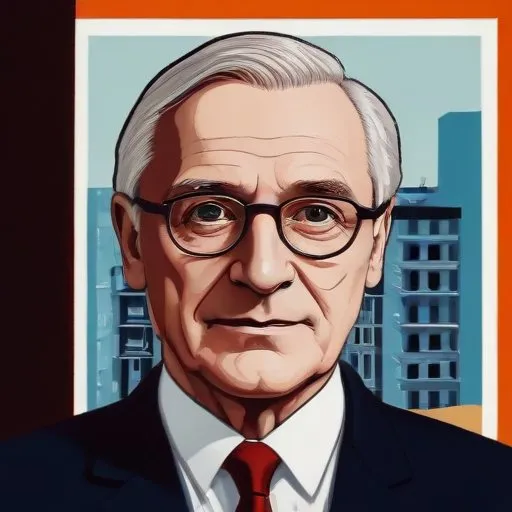
A pioneering urban planner and architect who revolutionized urban design with his functional, modernist approach, creating entire cities and neighborhoods that prioritized community and green spaces.
Ernst May, a German architect and city planner, is renowned for revolutionizing urban design in Frankfurt am Main during the Weimar Republic period. His innovative approach to urban planning, which incorporated decentralized planning and community-centric design, earned him international recognition and influenced the development of cities worldwide.
Born on July 27, 1886, in Frankfurt am Main, May was the son of a leather goods manufacturer. He pursued his education in the United Kingdom, studying under Raymond Unwin, a prominent English architect, and absorbing the principles of the garden city movement. May later completed his studies at the Technical University of Munich, where he worked under Friedrich von Thiersch and Theodor Fischer, a cofounder of the Deutscher Werkbund.
In 1925, May was appointed city architect and planner for Frankfurt am Main, a position that gave him broad powers of zoning, financing, and hiring. During his tenure, he initiated the large-scale housing development program, "New Frankfurt," which aimed to address the city's housing shortage and political instability. May's developments were remarkable for their time, featuring compact, semi-independent communities equipped with amenities like playgrounds, schools, theaters, and common washing areas.
In 1930, May exported his urban design techniques to the Soviet Union, where he worked on developing cities under Stalinist rule. During this period, he established twenty cities in just three years, including Magnitogorsk. May's "brigade" of German architects and planners made significant contributions to the development of Soviet cities, despite the challenges posed by the Stalinist regime.
As the Nazis seized power in Germany, May's travels left him stateless. He spent many years in African exile, where he continued to work on urban planning projects. May's experiences during this period deeply influenced his philosophies on urban design and community development.
Near the end of his life, May returned to Germany, where he continued to work on urban planning projects. His contributions to the field of architecture and urban planning have left a lasting legacy, influencing urban design principles and practices worldwide. Ernst May passed away on September 11, 1970, but his vision for urban renaissance continues to inspire architects, planners, and city dwellers alike.
"The city is not just a collection of buildings, but a living organism that needs to be nurtured and shaped."
"Urban planning is not just about designing buildings, but about creating communities that thrive."
Born in 1883
A pioneer of modernist architecture, he designed iconic buildings that blended functionality with aesthetics, including the John F. Kennedy Federal Building. His work continues to inspire architects and designers today.
Born in 1886
A pioneering architect who revolutionized modern skyscraper design with sleek, minimalist, and functional buildings that redefined urban landscapes. His iconic creations continue to inspire architects and influence city skylines.
Born in 1887
A pioneer of modern architecture, famous for designing innovative, functional, and visually striking buildings that transformed urban landscapes. His works continue to inspire architects and designers worldwide.
Born in 1867
Visionary architect behind iconic, harmonious structures that blend seamlessly into their surroundings, redefining modern American architecture.
Born in 1888
A pioneering artist and educator who explored the properties of color and its effects on human perception through his work, creating a new language of art.
Born in 1902
A pioneering architect and academic who designed iconic buildings, including the Ameritrust Tower, blending modernism with functionality. Known for his innovative use of materials and minimalist style.
Born in 1910
A Finnish-American architect and furniture designer who created iconic, futuristic structures and designs that blended art and functionality, including the iconic Gateway Arch.
Born in 1885
A Swedish architect and academic who designed the iconic Stockholm Public Library, a masterpiece of Nordic classicism that has inspired generations of architects and designers.
