


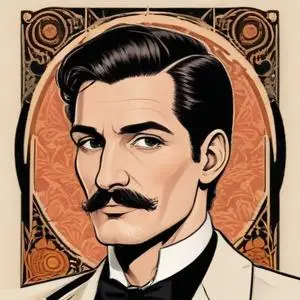
A Russian-French illustrator and designer, renowned for his opulent, Art Deco-inspired fashion illustrations and theatrical set designs that epitomized luxury and glamour in the early 20th century.
Romain de Tirtoff, better known by his pseudonym Erté, was a 20th-century Russian-born French artist and designer who left an indelible mark on various fields, including fashion, jewelry, graphic arts, costume, set design, and interior decor. With a career spanning over seven decades, Erté's work continues to inspire and influence artists, designers, and art enthusiasts to this day.
Born on November 23, 1892, in Saint Petersburg, Russia, Tirtoff was raised in a distinguished family with roots tracing back to 1548. His father, Pyotr Ivanovich Tyrtov, served as an admiral in the Russian Fleet. From an early age, Erté was drawn to the world of theater and dance, but it was his passion for painting and design that ultimately defined his career path.
In 1907, at the tender age of 15, Erté created his first sculpture, Demoiselle à la balancelle, while studying in Paris. This early work, although lesser known, showcased his affinity for Art Nouveau. Erté's decision to pursue a career in design was met with strong objections from his father, who wanted him to follow in the family's naval tradition. However, Erté was determined to forge his own path, and his pseudonym allowed him to do so without upsetting his family.
In 1910, Erté moved to Paris, where he lived with Prince Nicolas Ouroussoff until the prince's death in 1933. During this time, he worked with the renowned designer Paul Poiret and secured his first substantial contract with Harper's Bazaar magazine in 1915. This marked the beginning of a long and fruitful career, with Erté going on to design costumes and stage sets for theater, film, and opera.
Erté's extensive repertoire includes:
Erté's work has inspired generations of artists, designers, and art enthusiasts. His designs continue to influence contemporary fashion, jewelry, and art, with many of his works remaining timeless and iconic. Erté's legacy extends beyond his artistic contributions, as he paved the way for future artists and designers to explore and push the boundaries of their craft.
Today, Erté's work can be found in museums and private collections worldwide, including the Metropolitan Museum of Art, the Victoria and Albert Museum, and the Musée des Arts Décoratifs. His contributions to the world of art and design continue to captivate and inspire, ensuring his place as one of the most multifaceted and beloved artists of the 20th century.
Born in 1879
A pioneering couturier who revolutionized fashion with exotic, opulent designs and fragrances, introducing the concept of lifestyle branding. He freed women from corsets and introduced a more relaxed, modern silhouette.
Born in 1883
Founded the iconic fashion house that revolutionized women's fashion with modernist and liberated styles, introducing the little black dress and No. 5 perfume.
Born in 1880
A pioneer of Fauvism, a style characterized by vivid colors and energetic brushstrokes, creating a new language of art that paved the way for modernist movements.
Born in 1877
A Fauvist painter and illustrator celebrated for vibrant, expressive works that captured the essence of modern life, from landscapes to still lifes, and even textiles and ceramics.
Born in 1881
A pioneering artist who transformed modern art with pioneering Cubist works, creating a new visual language that continues to inspire and influence art, design, and culture.
Born in 1869
A pioneering artist who revolutionized modern art with bold, expressive, and colorful works that blurred the lines between painting and sculpture, creating a new language of form and color.
Born in 1889
A renowned French creative force, celebrated for his innovative and surreal works that blurred the lines between literature, art, and cinema, leaving an indelible mark on 20th-century culture.
