


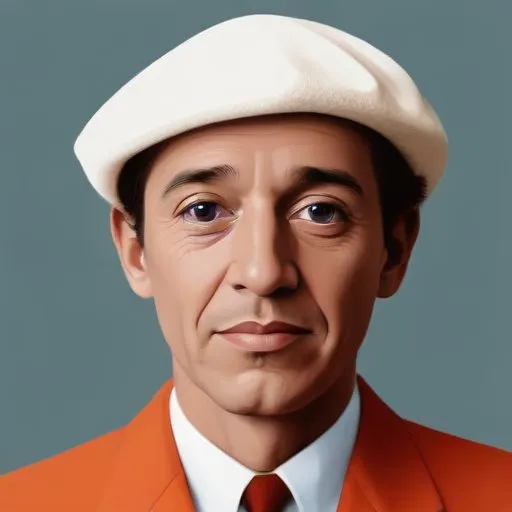
A self-taught artist known for his vibrant, whimsical, and often surreal paintings that blend elements of abstraction, figuration, and collage. His work explores themes of identity, community, and the human condition.
Eugene J. Martin, a renowned African American visual artist, is celebrated for his imaginative and complex mixed media collages, humorous pencil and pen drawings, and whimsical paintings that blend abstraction and representation. His unique style, which he coined "satirical abstracts," has captivated art enthusiasts for decades.
Born on July 24, 1938, on Capitol Hill, Washington D.C., Martin grew up in a world of creativity and chaos. His father, James Walter Martin, was an itinerant jazz musician, and his mother, Margaret Helen Dove, instilled in him a love for art. After his mother's untimely death in 1942, Martin and his brother Jerry were placed in foster care, where they experienced a tumultuous childhood.
As a child, Martin found solace in art, drawing realistic portraits and nature scenes on the farm where he was placed in foster care. He also developed a passion for music, playing the upright bass, thunder bass, and slide trombone in the local rhythm and blues band, The Nutones. This dichotomy of art and music would later influence his artistic style.
After attending the Corcoran School of Art from 1960 to 1963, Martin embarked on a professional fine arts career, guided solely by his artistic integrity. He shunned conformity to any single art movement, embracing individuality and an eclectic approach to art. His work defies categorization, blending satire, abstraction, and representation in a way that is both whimsical and thought-provoking.
Martin's "satirical abstracts" are a hallmark of his oeuvre, characterized by a wry sense of humor and a touch of the surreal. His paintings and collages often feature whimsical allusions to animal, machine, and structural imagery, set against a backdrop of pure, constructed, biomorphic, or disciplined lyrical abstraction. These works are a testament to his ability to balance the absurd with the profound.
Eugene J. Martin's contributions to the art world are undeniable. He has inspired generations of artists to push the boundaries of creativity and challenge the status quo. His work can be found in numerous private collections and institutions, including the National Gallery of Art, the Smithsonian American Art Museum, and the Phillips Collection.
Eugene J. Martin's legacy extends beyond his artwork, influencing contemporary artists, designers, and musicians. His commitment to individuality and artistic integrity serves as a beacon for creatives seeking to break free from the constraints of conventional thinking.
Eugene J. Martin passed away on January 1, 2005, leaving behind a body of work that continues to inspire and delight. His art remains a testament to the power of creative vision, reminding us that even in the face of adversity, art can be a source of solace, liberation, and joy.
65 Years Old
A pioneering artist who merged graffiti, abstract expressionism, and neo-expressionism to create vibrant, thought-provoking works that explored race, identity, and social justice. His art continues to inspire and challenge audiences today.
98 Years Old
A pioneer of pop art, creating iconic silkscreen prints of consumer products and celebrities, and experimenting with avant-garde films.
68 Years Old
Vibrant, colorful, and thought-provoking street art that often tackled social issues like racism, inequality, and AIDS awareness. His iconic characters and murals continue to inspire and educate.
Born in 1925
A pioneer of pop art, combining found objects and images to create innovative, thought-provoking works that blurred the lines between art and everyday life.
96 Years Old
A pioneer of pop art, creating enigmatic works that explore the relationship between perception, reality, and meaning, often using common images like flags and targets.
98 Years Old
A renowned artist who blended painting and sculpture to create unique, expressive works that explored ancient mythology and modern abstraction. His distinctive style often featured scribbles, marks, and colorful splatters.
Born in 1923
A pioneering figure in modern art, known for bold, colorful, and geometric paintings and sculptures that explore the relationship between shape, color, and space. Their works are characterized by simplicity, precision, and a sense of playfulness.
Born in 1723
A 18th-century minister and philosopher who advocated for moral and political reform, and is best known for his influential writings on ethics, politics, and economics.
