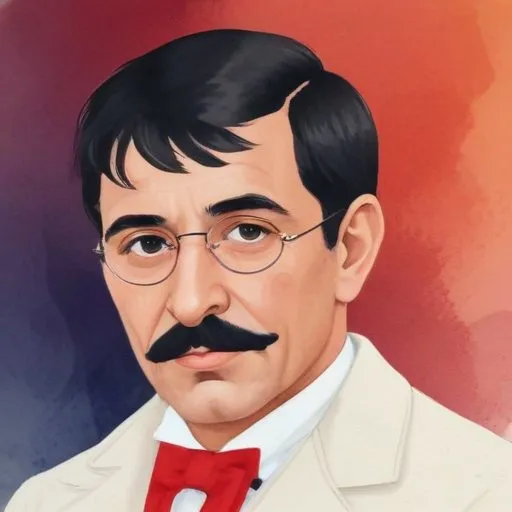
Eugne Charles Catalan: The Mathematical Maverick
A Legacy of Numbers and Shapes
Eugne Charles Catalan was a French and Belgian mathematician who left an indelible mark on the world of mathematics, particularly in the realms of continued fractions, descriptive geometry, number theory, and combinatorics. He is perhaps most famously known for introducing the Catalan numbers, a sequence of numbers that has become a cornerstone in combinatorial mathematics.
Early Life and Education
Born on May 30, 1814, in Bruges, Belgium (then under Dutch rule), Catalan was the only child of Joseph Catalan, a French jeweler. In 1825, he traveled to Paris to pursue his passion for mathematics at the cole Polytechnique, where he met renowned mathematician
Joseph Liouville. However, his academic journey was briefly interrupted in 1834 when he was expelled along with his fellow students due to political reasons. Undeterred, Catalan resumed his studies in 1835 and graduated that summer.
A Career of Numbers and Politics
Catalan's academic career was marked by his strong left-wing political views, which led him to participate in the 1848 Revolution. Despite this, he managed to cultivate a remarkable career, teaching at various institutions, including Charlemagne College, where he taught descriptive geometry. In 1865, he was appointed chair of analysis at the University of Lige, and later became the editor of a mathematical journal.
The Catalan Conjecture and Beyond
One of Catalan's most significant contributions to mathematics was the Catalan conjecture, a problem that remained unsolved for over a century until it was finally proved in 2002. He also discovered a periodic minimal surface in the space R
3, a breakthrough that has had far-reaching implications in mathematics and physics.
Personal Milestones and Key Life Events
- In 1833, Catalan met Joseph Liouville, who would later become a significant influence on his mathematical journey.
- In 1848, Catalan participated in the Revolution, showcasing his strong political convictions.
- In 1865, he was appointed chair of analysis at the University of Lige, a testament to his growing reputation as a mathematician.
- In 1879, he became the editor of a mathematical journal, where he published Paul-Jean Busschop's theory, despite initially rejecting it in 1873.
Impact on Modern Society
Catalan's contributions to mathematics have had a profound impact on modern society, influencing various fields such as computer science, physics, and engineering. His work on combinatorics has led to breakthroughs in data storage, encryption, and network analysis.
Philosophical Contributions and Beliefs
Catalan's mathematical philosophy was rooted in his strong belief in the importance of empirical evidence and rigorous proof. He was known for his meticulous approach to mathematics, often prioritizing simplicity and elegance over complexity and abstraction.
Legacy and Historical Context
Eugne Charles Catalan's legacy extends far beyond his mathematical contributions. He was a product of his time, living through the tumultuous years of the 19th century. His life and work reflect the complex interplay between politics, education, and intellectual curiosity that defined the epoch.
Trivia and Fun Facts
- Catalan was visited by the French police in 1849, who were searching for illicit teaching material at his home.
- He was an animated teacher, known for his engaging lecture style and ability to convey complex mathematical concepts in a clear and concise manner.
In Conclusion
Eugne Charles Catalan's remarkable life and work serve as a testament to the power of human curiosity and intellectual perseverance. His mathematical contributions continue to inspire and influence generations of mathematicians, scientists, and thinkers, cementing his place as one of the most important mathematicians of the 19th century.
FAQ
What was Eugène Charles Catalans contribution to mathematics?
Eugène Charles Catalan was a Belgian-French mathematician and academic who made significant contributions to several areas of mathematics, including number theory, algebra, and geometry. He is best known for his work on the Catalans conjecture, a famous problem in number theory.
What were Eugène Charles Catalans achievements as a mathematician?
As a dedicated and influential mathematician, Eugène Charles Catalan achieved several significant milestones, including the publication of several influential papers on number theory and algebra. He was also a prolific teacher and lecturer, and was known for his ability to communicate complex mathematical concepts to a broad audience.
How did Eugène Charles Catalan become interested in mathematics?
Eugène Charles Catalan became interested in mathematics at a young age, and was encouraged by his parents to pursue a career in science. He was educated at the University of Liège, where he studied under several prominent mathematicians.
What were Eugène Charles Catalans views on the importance of mathematics?
As a dedicated mathematician, Eugène Charles Catalan believed in the importance of mathematics as a tool for understanding the world around us. He advocated for the importance of mathematical education and was a strong supporter of mathematical research.
What is Eugène Charles Catalans legacy in the field of mathematics?
Eugène Charles Catalans legacy in the field of mathematics is that of a dedicated and influential mathematician who made significant contributions to several areas of mathematics. He is remembered as a pioneer in the field and a inspiration to future generations of mathematicians.