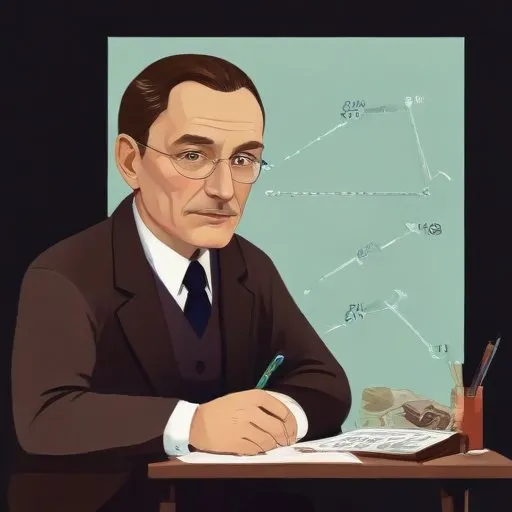
Evgraf Fedorov: The Russian Mathematician Who Cracked the Code of Symmetry
The Father of Modern Crystallography
Evgraf Stepanovich Fedorov, a Russian mathematician, crystallographer, and mineralogist, is renowned for his groundbreaking contributions to the field of crystallography. In 1891, Fedorov derived the 230 symmetry space groups, which now form the mathematical basis of structural analysis, revolutionizing the understanding of crystal structure and symmetry.
Early Life and Education
Born on December 10, 1853, in Orenburg, Russia, Fedorov's fascination with polytopes began at the tender age of 15. His father, a topographical engineer, encouraged his curiosity, which eventually led him to join the Gorny Institute at 26. Fedorov's meteoric rise culminated in his election as the first Director of the Institute in 1905.
Unraveling the Mysteries of Symmetry
Fedorov's most significant achievement lies in his derivation of the 230 symmetry space groups. This monumental work, published in 1891, provided a mathematical framework for analyzing crystal structures and paved the way for major breakthroughs in physics, chemistry, and materials science. His research also led to the discovery of the 17 possible wallpaper groups, which can tile a Euclidean plane.
Fedorov's Contributions to Crystallography
- Fedorov developed the Fedorov stage for polarizing microscopes, a crucial tool for studying crystal structures under precise angles of tilt and rotation.
- He published "Basics of Polytopes" in 1885, a seminal work that classified polytopes and introduced Fedorov polytopes, congruent polytopes that can completely fill space.
- His classic book, "The Symmetry of Regular Systems of Figures" (1891), remains a testament to his profound understanding of symmetry and its applications.
A Life Dedicated to Science
Fedorov's academic career spanned several institutions, including the Moscow Agricultural Institute (now the Timiryazev Academy), where he taught geology from 1895. Despite facing personal and professional challenges during the Russian Civil War, Fedorov continued to work tirelessly until his untimely death from pneumonia on May 21, 1919.
Legacy and Impact
Fedorov's pioneering work has had a profound impact on modern science and technology. His legacy extends beyond crystallography, influencing fields such as physics, chemistry, and materials science. His research has inspired generations of scientists, and his contributions continue to shape our understanding of the natural world.
In Memoriam
Evgraf Fedorov's remarkable life and work serve as a testament to the power of human curiosity and dedication. His groundbreaking research has left an indelible mark on the scientific community, ensuring that his legacy will continue to inspire and inform future generations of scientists and thinkers.
FAQ
What were Evgraf Fedorovs contributions to mathematics?
Fedorov was a Russian mathematician, crystallographer, and mineralogist who made significant contributions to the fields of crystallography and geometry.
What is the Fedorov theorem?
The Fedorov theorem is a fundamental result in geometry, proved by Fedorov, which relates to the structure of crystals and their symmetry groups.
What was Evgraf Fedorovs role in Russian mathematics?
Fedorov was a prominent figure in Russian mathematics, known for his contributions to the countrys mathematical scene and his influence on later mathematicians.
What were some of Evgraf Fedorovs most famous works?
Some of Fedorovs most famous works include his papers on the theory of crystals and his book The Symmetry of Crystals.
What legacy did Evgraf Fedorov leave behind?
Fedorovs legacy lies in his contributions to mathematics and his influence on later mathematicians, as well as his role in shaping the field of crystallography.