


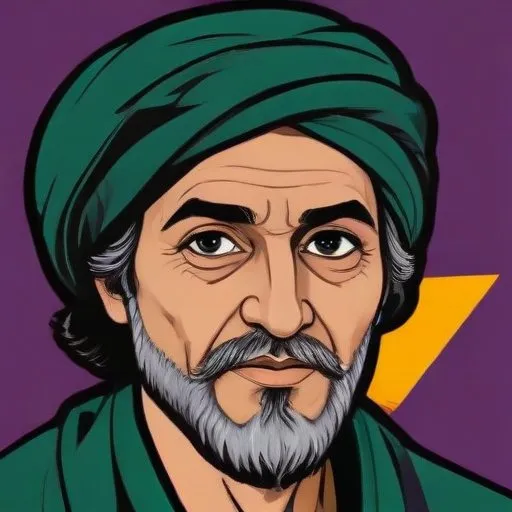
A 13th-century Persian poet and philosopher who wrote extensively on Sufism, spiritual growth, and the nature of God, leaving a lasting impact on Islamic mysticism. His works are still studied and revered today.
FakhralDin Iraqi, a renowned Sufi poet and mystic of the 13th century, is celebrated for his profound spiritual insights and literary masterpieces that continue to inspire and influence Islamic thought to this day. His works, characterized by their depth, eloquence, and spiritual fervor, have made him a stalwart figure in the realm of Islamic mysticism and Persian literature.
Born in 1213 CE in Hamadan, Iran, FakhralDin Iraqi was drawn to Sufism from an early age, captivated by the teachings of the great mystic, Rumi. His spiritual quest took him to the esteemed Sufi orders of the time, where he studied under the guidance of prominent Sufi masters. Iraqi's spiritual journey was marked by his intense devotion, ascetic practices, and a profound sense of humility, all of which are reflected in his poetry and writings.
FakhralDin Iraqi's literary legacy is immense, with his poetry and prose works ranking among the most celebrated in Persian literature. His magnum opus, Lama'at (Divine Flashes), is a testament to his mastery of language and his ability to convey complex spiritual concepts with elegance and precision. This influential work has been revered for centuries as a guide for spiritual seekers and a benchmark for Sufi literature.
Iraqi's philosophical contributions are rooted in his understanding of Sufism as a path to spiritual growth and self-realization. He believed in the unity of existence, where the individual ego is transcended, and the believer becomes one with the Divine. His concept of Wahdat al-Wujud (Unity of Existence) posits that God is the sole reality, and all else is a manifestation of His essence. This idea has had a profound impact on Islamic thought, influencing prominent Sufi thinkers and philosophers.
FakhralDin Iraqi's legacy extends beyond the realm of Sufism and literature, with his ideas and teachings influencing various aspects of modern society. His emphasis on spiritual growth, self-awareness, and compassion has inspired countless individuals, from philosophers and theologians to artists and writers. His works continue to be a source of guidance and inspiration for those seeking a deeper understanding of Islamic spirituality and mysticism.
"The eye of the soul is the polished mirror, and the light of the soul is the light of the Truth."
"The essence of the universe is the essence of God, and the universe is the manifestation of His essence."
FakhralDin Iraqi lived during a time of great cultural and intellectual flowering in the Islamic world. His works reflect the rich cultural heritage of the Persian and Arabic traditions, while his ideas have contributed significantly to the development of Sufi thought and Islamic philosophy. As a testament to his enduring legacy, Iraqi's works continue to be studied, revered, and translated around the world.
Iraqi's life was marked by significant events that shaped his spiritual journey and literary career. His meeting with the great Sufi master, Baha al-Din Zakariya, was a turning point in his life, and his subsequent studies under the guidance of prominent Sufi masters laid the foundation for his literary and philosophical contributions.
FakhralDin Iraqi's profound spiritual insights, literary mastery, and philosophical contributions have left an indelible mark on Islamic thought and literature. His works continue to inspire generations of scholars, writers, and spiritual seekers, ensuring his legacy as one of the most revered Sufi poets and mystics of all time.
Born in 1207
A 13th-century Persian poet and Sufi mystic who wrote spiritual and romantic poetry that explores the nature of love, spirituality, and the human condition. His works have transcended time and cultures, inspiring countless readers and seekers.
