


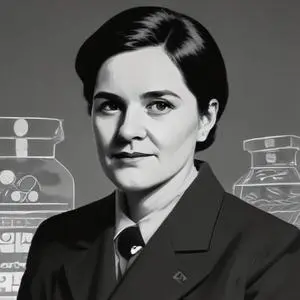
A pioneering doctor who blocked the approval of thalidomide in the US, saving countless lives from its devastating birth defects, and later crusaded for stronger drug regulations.
Dr. Frances Oldham Kelsey is famously credited with preventing a pharmaceutical disaster in the United States by refusing to approve thalidomide, a drug that caused severe birth defects, for market distribution in the 1960s. Her courageous stand, despite intense pressure from the drug's manufacturer, earned her international recognition as a champion of public health.
Frances Kathleen Oldham was born on July 24, 1914, in Cobble Hill, British Columbia, Canada. She attended St. Margarets School and later Victoria College (now University of Victoria) before enrolling at McGill University, where she received her Bachelor of Science (1934) and Master of Science (1935) degrees in pharmacology. Kelsey's academic excellence and determination paved the way for her to pursue a Ph.D. in pharmacology at the University of Chicago, which she completed in 1938.
Kelsey's work at the University of Chicago under Dr. E.M.K. Geiling exposed her to the potentially deadly effects of certain drugs. She assisted Geiling in researching unusual deaths related to elixir sulfanilamide, leading to the passage of the Federal Food, Drug, and Cosmetic Act of 1938. This experience instilled in Kelsey a deep understanding of the importance of stringent drug regulations and monitoring.
In 1960, Kelsey joined the U.S. Food and Drug Administration (FDA) as a medical reviewer, where she was tasked with evaluating new drug applications. When thalidomide came up for approval, Kelsey's scrutiny and skepticism led her to request additional safety data, despite intense lobbying from the drug's manufacturer, Richardson-Merrell. Her concerns eventually led to the drug's rejection, a decision that saved countless lives.
Frances Oldham Kelsey's unwavering commitment to public health led to significant reforms in the pharmaceutical industry. Her actions prompted Congress to pass stricter drug regulations, including the Kefauver-Harris Amendments, which mandated more rigorous drug testing and monitoring. Today, Kelsey is celebrated as a pioneer in her field, and her legacy continues to inspire generations of scientists, researchers, and policymakers.
As we reflect on Dr. Kelsey's remarkable career, we are reminded that the pursuit of scientific knowledge must always be tempered by a deep respect for human life and a commitment to protecting the vulnerable.
Born in 1907
Pioneering biologist and environmentalist who exposed the dangers of pesticides and inspired the modern environmental movement through her groundbreaking book "Silent Spring".
Born in 1902
Pioneering geneticist who discovered transposons, mobile genetic elements that jump from one location to another in a genome, revolutionizing our understanding of genetic variation and evolution.
Born in 1920
A British scientist who contributed significantly to the discovery of the structure of DNA, providing high-quality X-ray crystallography images that helped James Watson and Francis Crick develop their famous model.
Born in 1922
Pioneering microbiologist who discovered the lambda phage, a bacteriophage that infects E. coli, and developed the replica plating technique, significantly advancing our understanding of microbial genetics.
75 Years Old
American physicist and astronaut who broke barriers as the first woman in space, inspiring generations of women in STEM fields. Founded a company to promote science education and literacy.
80 Years Old
A pioneering African American physicist who broke racial and gender barriers, known for her groundbreaking research in theoretical physics, particularly in the fields of condensed matter physics and particle physics.
Born in 1912
A pioneering experimental physicist who disproved a fundamental concept in physics, the law of parity, and made groundbreaking contributions to particle physics.
Born in 1906
A pioneering physicist who uncovered the nuclear shell structure, earning a Nobel Prize for her groundbreaking work in nuclear physics. Her research revolutionized our understanding of atomic nuclei.
