


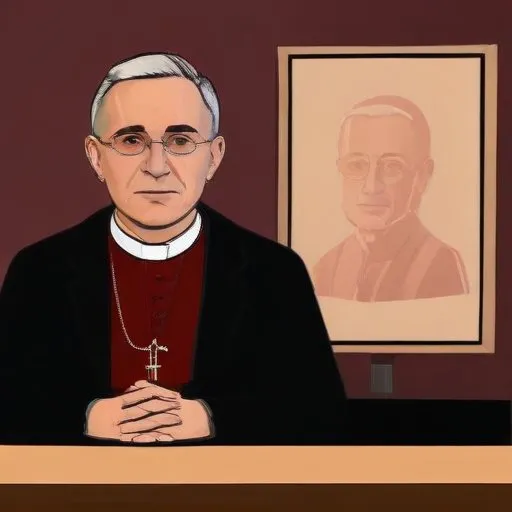
A Canadian priest who applied psychology to understand religious experiences and developed the concept of "mystical consciousness", making significant contributions to the field of psychology of religion.
Francis Aveling was a Canadian psychologist and Catholic priest who made significant contributions to the field of psychology, earning him a reputation as a distinguished scholar and academic. He is best known for his work in phenomenology, particularly in the areas of consciousness and the thought process.
Born on December 25, 1875, in St. Catharines, Ontario, Aveling was educated at Bishop Ridley College in Ontario and McGill University. He later pursued his studies at Keble College, University of Oxford, England.
In 1896, Aveling was received into the Roman Catholic Church by Father Luke Rivington. He then entered the Pontificio Collegio Canadese in Rome, where he earned his doctor of divinity degree. Aveling was ordained to the priesthood in 1899 and went on to serve as a curate in Tottenham and as the first rector of Westminster Cathedral Choir School.
Aveling's academic achievements are impressive, with doctorates in philosophy, science, and letters from the University of Louvain, University of London, and University of London, respectively. His work, "On the Consciousness of the Universal and the Individual: A Contribution to the Phenomenology of the Thought Process," earned him the Carpenter Medal in 1912.
He taught at University College, London, and later at King's College, London, where he was promoted to reader and eventually to professor of psychology. Aveling also served as an extern examiner in philosophy at the National University of Ireland and as a lecturer in pedagogical methods for the London County Council.
Aveling authored several books and was the doctoral advisor of renowned psychologist Raymond Cattell. His work had a significant impact on the field of psychology, particularly in the areas of phenomenology and consciousness.
In 1925, Aveling married Ethel Dancy of Steyning, Sussex. He passed away on March 6, 1941, leaving behind a legacy of academic excellence and contributions to the field of psychology.
Aveling's work continues to influence modern psychology, and his contributions to the field remain relevant today. His emphasis on the importance of consciousness and the thought process has paved the way for further research and understanding in these areas.
Aveling's work is characterized by his profound insights into the human psyche. One of his notable quotes is: "The consciousness of the universal is the foundation of all knowledge."
Aveling's remarkable career, marked by his academic achievements, contributions to psychology, and dedication to his faith, has left an indelible mark on the field of psychology.
Born in 1842
Pioneering philosopher and psychologist who explored the nature of consciousness, free will, and religious experience, and is known for his pragmatic approach to philosophy and psychology.
Born in 1856
Pioneering psychoanalyst who developed theories on the subconscious mind, childhood experiences, and the structure of personality, revolutionizing our understanding of human behavior and psychology.
Born in 1875
Developed the concept of collective unconscious and archetypes, and founded analytical psychology, which emphasizes the integration of opposites and the process of individuation.
Born in 1904
Developed the theory of operant conditioning, which explores the relationship between behavior and environment, and invented the "Skinner box" to study learning and behavior.
Born in 1896
Developed groundbreaking theories on child cognitive development and learning, emphasizing active discovery and hands-on experience. His work has shaped modern education and parenting practices.
Born in 1900
A German psychologist and sociologist who developed the concept of "social character" and explored the relationship between psychology and society, known for his humanistic and socialist approach.
Born in 1908
Developed the Hierarchy of Needs, a pyramid-shaped model that prioritizes human needs, from basic physiological needs to self-actualization and personal growth. His work focuses on human motivation and the pursuit of happiness.
Born in 1902
Developed the theory of psychosocial development, which proposes that individuals go through eight stages of development from infancy to old age, each with its own unique challenges and opportunities. His work has had a significant impact on our understanding of human development and identity formation.
