


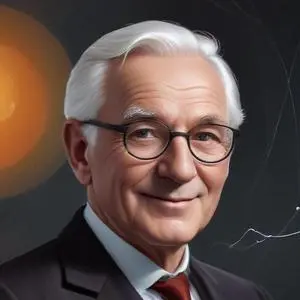
A Nobel Prize-winning chemist who discovered the depletion of the ozone layer and its link to chlorofluorocarbons, leading to a global ban on their use. His work saved the planet from a major environmental disaster.
When it comes to saving the planet, few individuals have made a more significant impact than Frank Sherwood Rowland, the American chemist who discovered that chlorofluorocarbons (CFCs) were responsible for depleting the ozone layer. This groundbreaking finding not only earned him a Nobel Prize in Chemistry in 1995 but also led to a global effort to phase out the use of CFCs and protect the Earth's atmosphere.
Born on June 28, 1927, in Delaware, Ohio, Rowland's fascination with science began at a young age. He accelerated through high school, graduating at just 16, and went on to attend Ohio Wesleyan University. During his high school summers, he worked at a local weather service station, where he developed a passion for systematic experimentation and data collection.
Rowland's academic career spanned several prestigious institutions, including Princeton University, the University of Kansas, and the University of California, Irvine, where he spent the majority of his career. It was during his time at Irvine that he began collaborating with Mario J. Molina, a partnership that would lead to their Nobel-winning discovery.
Rowland's research focused on atmospheric chemistry and chemical kinetics, with a particular emphasis on the effects of human activities on the environment. His work led to numerous publications and earned him several awards, including election to the National Academy of Sciences in 1978 and presidency of the American Association for the Advancement of Science in 1993.
In the early 1970s, Rowland and Molina began investigating the effects of CFCs on the ozone layer. Their research revealed that these commonly used chemicals, found in aerosol cans and refrigerators, were responsible for the depletion of the ozone layer. This finding sparked a global effort to reduce the use of CFCs and led to the signing of the Montreal Protocol in 1987, an international treaty aimed at phasing out the production and consumption of ozone-depleting substances.
Rowland's contributions to science were recognized with numerous awards and honors, including:
Through his tireless efforts, Rowland has left an indelible mark on the scientific community and will forever be remembered as a champion of the environment.
83 Years Old
A Mexican chemist and Nobel laureate who discovered the Antarctic ozone hole and pioneered research on the depletion of the ozone layer, contributing significantly to our understanding of climate change.
92 Years Old
A Nobel Prize-winning chemist and engineer who discovered the ozone hole and coined the term "Anthropocene" to describe humanity's impact on the environment.
78 Years Old
The 45th Vice President of the United States and Nobel Prize laureate is a prominent advocate for environmental protection, particularly climate change awareness, and has produced influential documentaries on the subject.
83 Years Old
Acclaimed filmmaker behind gritty, stylish, and intense crime dramas and thrillers, often exploring themes of morality and redemption. Known for iconic films like "Heat" and "Collateral".
