


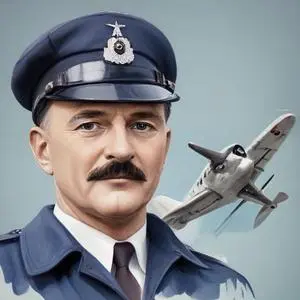
Developed the first practical jet engine, revolutionizing air travel and modern warfare. This innovation transformed the aviation industry, enabling faster and more efficient flight.
Frank Whittle is credited with inventing the turbojet engine, a revolutionary innovation that transformed the aviation industry. His pioneering work in the field of jet propulsion earned him recognition as one of the most influential figures in the history of aviation.
Frank Whittle was born on June 1, 1907, in Coventry, England. From an early age, he demonstrated an aptitude for engineering and a fascination with flying. Despite being rejected by the Royal Air Force (RAF) initially, Whittle persevered and was eventually accepted into the No. 2 School of Technical Training.
Whittle's true innovation came when he formulated the fundamental concepts of the turbojet engine while writing his thesis. He took out a patent on his design in 1930, laying the foundation for his future work.
Without official support, Whittle, along with two retired RAF servicemen, formed Power Jets Ltd to develop his engine. Despite limited funding, they successfully built a prototype, which first ran in 1937.
Whittle's journey was not without its challenges. The lack of official support and limited resources took a toll on his health, leading to a nervous breakdown in 1940.
Despite these setbacks, Whittle's innovations continued to gain recognition. In 1944, Power Jets was nationalized, and Whittle's engines became a crucial component of the British war effort.
Frank Whittle's contributions to aviation have had a lasting impact on modern society. His turbojet engine enabled the development of high-speed flight, transforming the airline industry and paving the way for modern commercial aviation.
Frank Whittle's achievements were recognized with numerous awards and honors, including:
Frank Whittle's remarkable story serves as a testament to the power of innovation and perseverance. His groundbreaking work has left an indelible mark on the history of aviation, and his legacy continues to inspire generations of engineers, inventors, and innovators.
