


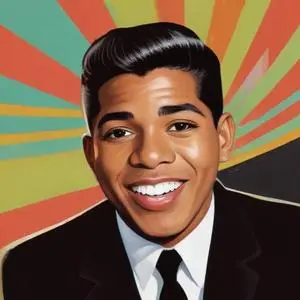
Lead singer of the Teenagers, known for his smooth, soulful voice and hit songs like "Why Do Fools Fall in Love" and "Goody Goody" that helped define the sound of doo-wop.
Frankie Lymon is best known as the boy soprano lead singer of the New York City-based doo-wop group The Teenagers, and his iconic song "Why Do Fools Fall in Love" that topped the charts in 1956. With his smooth, high-pitched voice and charismatic stage presence, Lymon became a sensation in the music industry, paving the way for future generations of rock and roll artists.
Franklin Joseph Lymon was born on September 30, 1942, in Washington Heights, New York City, to Jeanette and Howard Lymon. Growing up in a struggling family, Lymon began working as a grocery boy at the age of 10 to support his family. However, his passion for music led him to join a local doo-wop group, The Coupe De Villes, at the age of 12.
As Lymon's talent and confidence grew, he became the lead singer of The Premiers, a group that would eventually become The Teenagers. The group's original lineup consisted of five boys, all in their early to mid-teens, with an integrated mix of African American and Puerto Rican members.
In 1956, The Teenagers released their debut single "Why Do Fools Fall in Love," which became an overnight sensation, topping the charts and selling over 2 million copies. The song's success catapulted Lymon to stardom, earning him the title of the "Golden Voice of Rock and Roll."
The Teenagers went on to release several more hits, including "I Want You to Be My Girl" and "Goody Goody." Lymon's unique voice and style were instrumental in shaping the sound of early rock and roll, influencing artists such as Elvis Presley, Little Richard, and The Platters.
In 1957, Lymon went solo, but his career began to falter. Despite releasing several solo albums, he struggled to replicate the success of The Teenagers. The decline of his career was further exacerbated by his personal struggles with drug addiction.
On February 27, 1968, Lymon was found dead on the floor of his grandmother's bathroom, a victim of a heroin overdose. He was just 25 years old.
Frankie Lymon's contributions to rock and roll are undeniable. He was posthumously inducted into the Rock and Roll Hall of Fame in 1993 as a member of The Teenagers. His life was dramatized in the 1998 film "Why Do Fools Fall in Love."
Lymon's music continues to inspire new generations of artists and fans alike. His legacy serves as a testament to the power of music to bring people together and transcend cultural boundaries.
Frankie Lymon's story is a testament to the power of music to bring people together and transcend cultural boundaries. His legacy continues to inspire new generations of artists and fans alike, ensuring that his music will live on forever.
82 Years Old
Legendary vocalist and iconic diva of Motown, known for powerful voice, glamorous style, and hits like "I Will Survive" and "Ain't No Mountain High Enough".
97 Years Old
A rock 'n' roll pioneer who blended blues, R&B, and rock to create a unique sound, influencing many famous musicians with his innovative guitar playing and songwriting style.
99 Years Old
Rock 'n' roll pioneer who wrote and performed iconic hits like "Johnny B. Goode" and "Maybellene", blending country, blues, and rhythm to create a unique sound.
93 Years Old
A flamboyant and charismatic rock 'n' roll pioneer, known for hits like "Tutti Frutti" and "Good Golly Miss Molly", blending gospel, blues, and boogie-woogie styles.
90 Years Old
A rock 'n' roll pioneer, known for his energetic stage performances and hits like "Great Balls of Fire" and "Whole Lotta Shakin' Goin' On".
87 Years Old
Rockabilly pioneer and teen idol, known for hits like "Summertime Blues" and "Twenty Flight Rock", influencing many British Invasion bands.
91 Years Old
Rockabilly pioneer and guitarist known for his energetic stage performances and hits like "Be-Bop-A-Lula"
98 Years Old
A legendary singer-songwriter and pianist who blended boogie-woogie piano with rhythm and blues to create a unique sound, known for hits like "Blueberry Hill" and "Ain't That a Shame".
