


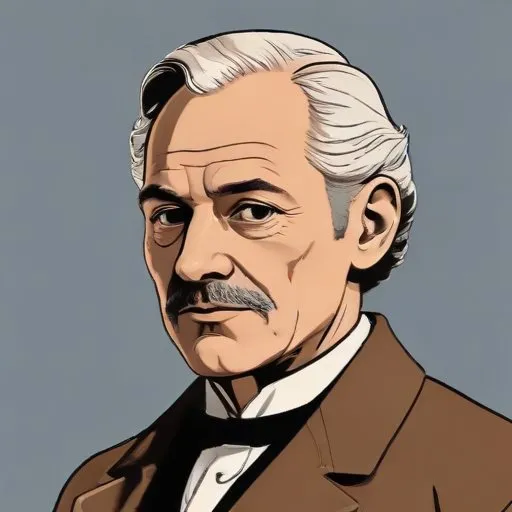
Austrian geologist and curator who contributed significantly to the field of paleontology, particularly in the discovery of fossils and the study of ancient life forms.
Franz Ritter von Hauer was a renowned Austrian geologist who made significant contributions to the field of geology, particularly in the study of Alpine regions and the creation of the first geological map of Austro-Hungary. He is best known for his meticulous work on the Cephalopoda of the Triassic and Jurassic formations, which led to the discovery of 89 new species and the establishment of the Middle and Late Triassic stratigraphical units of deep shelf environments.
Born on January 30, 1822, in Vienna, Austria, Franz von Hauer was the son of Joseph von Hauer, a distinguished high Austrian official and authority on finance and palaeontologist. This exposure to science and academia at a young age likely sparked von Hauer's interest in geology, which he went on to study at the mining academy of Schemnitz from 1839 to 1843.
In 1846, von Hauer became an assistant to Wilhelm von Haidinger at the mineralogical museum in Vienna, marking the beginning of his illustrious career. Just three years later, he joined the imperial geological institute, and in 1866, he was appointed director. This position allowed him to oversee and contribute to numerous geological projects, including the creation of his magnum opus, the Geological Map of Austro-Hungary.
This monumental work, published in 12 sheets between 1867 and 1871, with a fourth edition released in 1884, was a groundbreaking achievement that showcased von Hauer's meticulous attention to detail and expertise in geology. The map, which included Bosnia and Montenegro, was accompanied by a series of explanatory pamphlets, making it an invaluable resource for geologists and scientists.
Von Hauer's contributions to geology were recognized and celebrated by his peers. In 1874, he was elected as a member to the American Philosophical Society, and in 1882, he was awarded the prestigious Wollaston medal by the Geological Society of London. He was also elected as a foreign correspondent of the Geological Society of London, a testament to his international reputation.
In 1886, von Hauer became superintendent of the Imperial Natural History Museum in Vienna, where he continued to work until his death on March 20, 1899. In 1892, he was appointed as a lifemember of the upper house (Herrenhaus) of the Austrian parliament. The mineral Hauerite was named in honor of both Franz von Hauer and his father, Joseph von Hauer, a fitting tribute to their contributions to science.
Franz Ritter von Hauer's legacy extends far beyond his numerous publications and awards. His work has had a lasting impact on the field of geology, and his meticulous attention to detail has inspired generations of scientists. As we reflect on his life and achievements, we are reminded of the significance of dedication, hard work, and a passion for discovery.
