


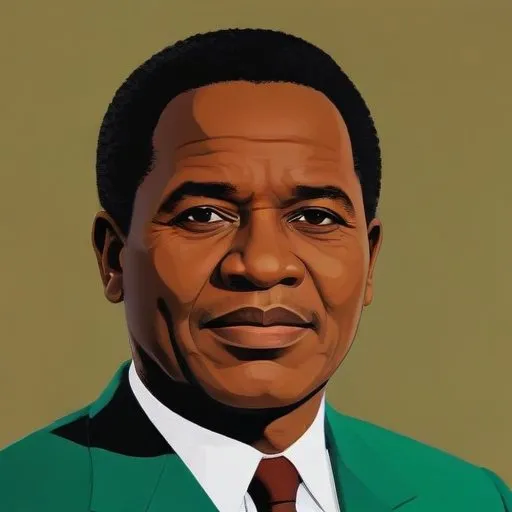
The second President of Zambia, who served from 1991 to 2002, is known for introducing multiparty democracy and overseeing the country's transition from a one-party state. He's also infamous for corruption and embezzlement allegations.
Frederick Chiluba, the second president of Zambia, is known for his remarkable journey from a trade union leader to the country's top office, serving from 1991 to 2002. He led the Movement for Multiparty Democracy (MMD) to victory in the country's first multiparty presidential election in 1991, marking a significant shift from the one-party rule of Kenneth Kaunda.
Born on April 30, 1943, in Luapula Province, Zambia, Chiluba grew up in a humble background. He attended Mambilima Mbolo special school and later Kawambwa boys technical Secondary School, where he was expelled in the second year for political activities.
Before entering politics, Chiluba worked as a bus conductor and later as an accounts assistant at Atlas Copco. He eventually joined the National Union of Building, where his leadership skills earned him recognition.
In 1991, Chiluba led the MMD to a landslide victory in the presidential election, defeating longtime President Kenneth Kaunda. He was reelected in 1996, cementing his position as a prominent figure in Zambian politics.
During his presidency, Chiluba introduced several reforms aimed at promoting economic development, including the privatization of state-owned companies and the encouragement of foreign investment.
Chiluba was married to Vera Tembo, with whom he had nine children, before divorcing in 2000 after 33 years of marriage. Tembo went on to pursue a political career, becoming MMD Chairperson for Women's Affairs, being elected to the Zambian Parliament, and serving as deputy Minister of the Environment in 2006.
In 2002, Chiluba married his third wife, Regina Mwanza, the former chairperson of women's affairs for the MMD, in Lusaka.
Chiluba's presidency was marked by both praise and criticism. While he was credited with stabilizing the economy and promoting democracy, he was also accused of corruption and mismanagement.
After leaving office, Chiluba was the subject of a long investigation and trial regarding alleged corruption. He was eventually acquitted in 2009.
Despite the controversies surrounding his presidency, Chiluba's legacy continues to shape Zambia's political landscape. He played a crucial role in promoting democracy and multiparty politics in the country.
As a trade union leader turned president, Chiluba's story serves as an inspiration to many, demonstrating the power of grassroots leadership and the importance of fighting for democratic values.
Frederick Chiluba's remarkable journey, though not without its challenges, leaves behind a lasting impact on Zambia's political history, making him a significant figure in the country's quest for democracy and development.
Born in 1924
First president of Zambia, leading the country to independence from British colonial rule and advocating for African unity and development.
78 Years Old
A Zambian lawyer and politician who served as the 3rd President of Zambia, known for his efforts to combat corruption and promote economic development in his country. He was a key figure in shaping Zambia's modern political landscape.
89 Years Old
A Zambian police officer-turned-politician who served as the 5th President of Zambia, known for his populist policies and anti-Chinese rhetoric. He's remembered for his efforts to increase the country's economic independence.
78 Years Old
A Zambian lawyer and politician who served as the 3rd President of Zambia, known for his efforts to combat corruption and promote economic development in his country. He was a key figure in shaping Zambia's modern political landscape.
