


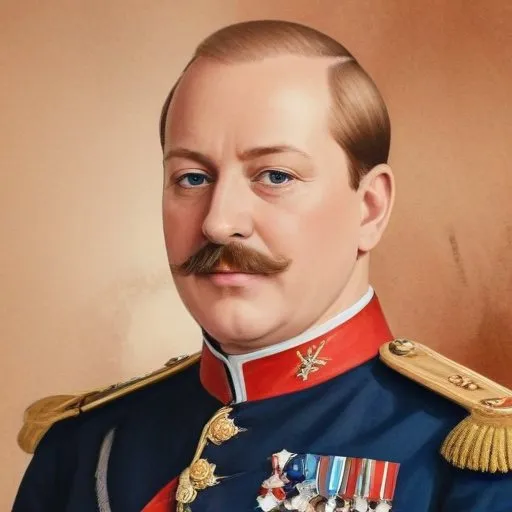
A Danish prince who played a key role in the Second Schleswig War and later became the King of Denmark, known for his brief but significant reign.
Frederick VIII, Duke of Schleswig-Holstein, is best known for his claim to the throne of Schleswig-Holstein, which was disputed by Prussia, and for being a Danish prince with the most Danish ancestry in his generation. Although he held the title of Duke of Schleswig-Holstein from 1863, Prussia took overlordship and real administrative power, making his rule more symbolic than practical.
Frederick VIII was born on July 6, 1829, to Christian August II, Duke of Schleswig-Holstein-Sonderburg-Augustenburg and Countess Louise Sophie of Danneskiold-Samsoe. His family belonged to the House of Oldenburg, a royal house that included all the medieval Scandinavian royal dynasties among its distant forebears.
Frederick's claim to the throne was rooted in his ancestry. He descended from the medieval Danish House of Estridsen via Christian I of Denmark's ancestress Richeza of Denmark, Lady of Werle, the daughter of Eric V of Denmark. Additionally, he descended from Eric V's son Christopher II of Denmark, a lineage that no heir or monarch of Denmark had been descended from since Christopher III of Denmark.
Frederick's ancestry set him apart from his rivals. His mother was from an ancient Danish family, Danneskiold-Samsoe, and his paternal grandmother Louise Auguste of Denmark was a royal princess. His paternal grandfather, Frederik Christian II, Duke of Augustenborg, numbered two ladies of Danish high nobility as his grandmothers, Danneskiold-Samsoe and Reventlow, and one Danish Countess as paternal great-grandmother Ahlefeldt-Langeland.
Frederick VIII's claim to the throne may have been symbolic, but it highlights the complexities of European royal politics during the 19th century. His story serves as a reminder of the intricate web of alliances and rivalries that shaped the continent's history.
In conclusion, Frederick VIII, Duke of Schleswig-Holstein, may not have held significant power, but his claim to the throne and unique ancestry make him an fascinating figure in European royal history.
Born in 1818
The King of Denmark who unified the country and founded the modern Danish monarchy, known for his strong leadership and family ties to European royal houses.
Born in 1723
King of Denmark and Norway from 1746 to 1766, known for his cultural and economic reforms, as well as his patronage of the arts.
Born in 1845
The Russian monarch who ruled from 1881 to 1894, known for his conservative and nationalistic policies, as well as his efforts to reform the Russian Empire's government and economy.
Born in 1890
The last monarch of the Greek royal house, he reigned from 1922 to 1924 and again from 1935 to 1947, and is remembered for his tumultuous reign marked by exile, coups, and World War II.
Born in 1872
The first king of Norway after the country's independence from Sweden, he played a crucial role in maintaining Norway's sovereignty during World War II. He's revered for his bravery and leadership during the war.
