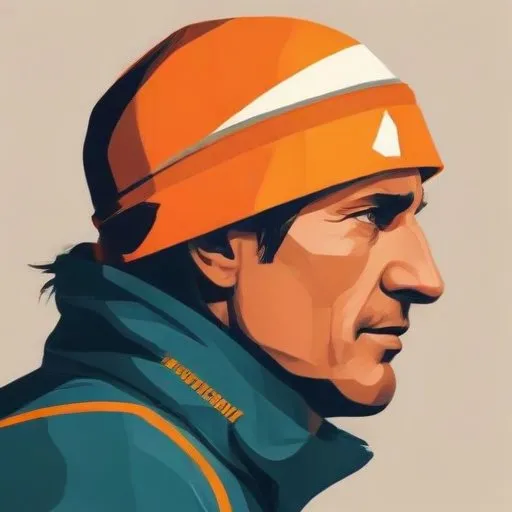
Fritz Wintersteller: The Austrian Climbing Pioneer
Austrian Mountaineer and Explorer
Fritz Wintersteller, an Austrian climber, made history by being part of the first ascent team to conquer Broad Peak, the ninth highest mountain in the world, in 1957. This remarkable feat, accomplished alongside
Hermann Buhl,
Kurt Diemberger, and
Marcus Schmuck, cemented Wintersteller's reputation as a seasoned mountaineer and explorer.
Early Climbing Career
Wintersteller's fascination with climbing began in the early 1940s, when he made his first notable ascent of Kleines Fieberhorn's southeast tower. This achievement marked the start of an illustrious career, characterized by numerous first ascents and traverses in the Austrian Alps. His impressive climbing resume includes the northwest face of Hochkogel, the direct west face of Wiesspitze, and the south ridge of Grosswand, among many others.
Broad Peak Expedition
The 1957 Karakoram expedition to Broad Peak was Wintersteller's most notable achievement. The team, consisting of Hermann Buhl, Kurt Diemberger, and Marcus Schmuck, successfully reached the forepeak on May 29, followed by the main summit on June 9. This historic ascent was a testament to Wintersteller's skill, determination, and adaptability in the face of extreme mountain conditions.
Alaska Adventures and Later Life
In his later years, Wintersteller shifted his focus to Alaska, where he embarked on extensive ski tours and rafting expeditions. Despite struggling with hip problems, he continued to remain active, often bicycling in his hometown of Salzburg, Austria.
Legacy and Impact
Fritz Wintersteller's contributions to mountaineering and exploration are undeniable. His feats have inspired generations of climbers and adventure-seekers. His commitment to pushing boundaries and exploring the unknown has left an indelible mark on the world of mountaineering.
First Ascents and Notable Climbs
- Kleines Fieberhorn, southeast tower (1943)
- Grosses Fieberhorn, south traverse (1943)
- Bratschenkopf, direct south face (1943)
- Zahringkogel, direct west face (1944)
- Watzmannfrau, northwest, left traverse (1944)
- Hochkogel, northwest face tower (1945)
- Grosswand, south ridge (1946)
- Wiesspitze, direct west face (1948)
- Lehender Kopf, direct west face (1948)
- Falkenstein, southeast ridge (1955)
- Westbyfijell, south face (1955)
- Skil Brum, north face (1957)
- Broad Peak, forepeak (1957)
- Broad Peak, main summit (1957)
Final Years and Recognition
Fritz Wintersteller passed away on September 15, 2018, leaving behind a legacy that will continue to inspire and motivate future generations of climbers and adventurers. His remarkable life, filled with exploration, discovery, and perseverance, serves as a testament to the power of human determination and the allure of the natural world.
FAQ
What notable mountains did Fritz Wintersteller climb?
Fritz Wintersteller, an Austrian mountaineer, conquered several iconic mountains, including the Eiger, Matterhorn, and Grand Teton. His most remarkable feat was being part of the first team to climb the North Face of the Eiger in 1938.
What was Fritz Winterstellers role in the Eiger expedition?
Wintersteller was the lead climber and navigator of the 1938 Eiger expedition, which successfully climbed the North Face of the Eiger, considered one of the most challenging climbs in the Alps.
How did Fritz Winterstellers mountaineering career begin?
Winterstellers passion for mountaineering started at a young age, inspired by his uncle, who was also a mountaineer. He began climbing in the Austrian Alps, eventually working his way up to more challenging peaks.
What awards did Fritz Wintersteller receive for his mountaineering achievements?
Wintersteller received several awards for his bravery and skill, including the Austrian Decoration for Science and Art and the Golden Medal of Honor for Services to the Republic of Austria.
What is Fritz Winterstellers legacy in the world of mountaineering?
Winterstellers pioneering climb of the Eigers North Face and his numerous other achievements have inspired generations of mountaineers, solidifying his place as one of the most iconic figures in the sport.