


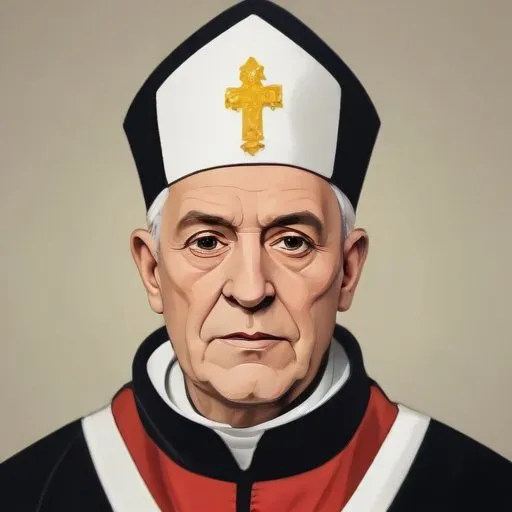
A 16th-century German Catholic archbishop who sparked a war over his conversion to Protestantism, causing a significant religious and political upheaval in the region.
Gebhard Truchsess von Waldburg, a name that echoes through the annals of history as a trailblazer who dared to challenge the authority of the Roman Catholic Church. Born on November 10, 1547, this German nobleman would go on to become the archbishopelector of Cologne, a position that would transform him into a lightning rod for controversy and revolution.
Gebhard's early life was marked by a strong sense of spirituality, which led him to pursue an ecclesiastical career. He won a closely contested election in the cathedral chapter of Cologne, defeating Ernst of Bavaria to become the archbishopelector in 1577.
However, it was his subsequent conversion to Calvinism and marriage to Agnes von Mansfeld-Eisleben, a Protestant canoness, that sparked a firestorm of controversy. Gebhard's decision to establish religious parity in the Electorate of Cologne, granting equal rights to Catholics and Calvinists, was seen as a direct challenge to the authority of the Roman Catholic Church.
The fallout from Gebhard's conversion and marriage was immediate and far-reaching. The Roman Catholic dominated cathedral chapter, backed by the Holy Roman Empire, refused to recognize his authority, sparking the Cologne War or Seneschal War. For six brutal years, Gebhard's supporters clashed with his opponents, resulting in the devastation of villages, cities, and abbeys throughout the electorate.
Despite his initial determination to hold onto power, Gebhard eventually surrendered his claim and retired to Strasbourg in 1588. His legacy, however, would continue to shape the course of history.
Gebhard's failed attempt to convert the electorate into a dynastic dignity marked a significant turning point in the Catholic Counter-Reformation. His loss strengthened the Catholic Church's grip on northern German states, paved the way for Jesuit influence in Cologne, and expanded the Wittelsbach family's influence in imperial politics.
Gebhard was born into an old Swabian noble family in the Frstenburg fortress of Heiligenberg. His father, William, was a Freiherr and Seneschal of Waldburg, as well as an Imperial councilor. Gebhard's family was descended from the Jacobin line of the House Jakob I Truchse von Waldburg.
Despite the controversy that surrounded his life, Gebhard's legacy is a testament to the power of conviction and the human spirit's ability to challenge the status quo. His story serves as a reminder that even in the face of adversity, courage and determination can leave an indelible mark on history.
Gebhard Truchsess von Waldburg's remarkable story is a tribute to the complexities and contradictions of human nature. Love, faith, power, and conviction – his life was a tumultuous mix of these and more, leaving behind a legacy that continues to captivate and inspire to this day.
