


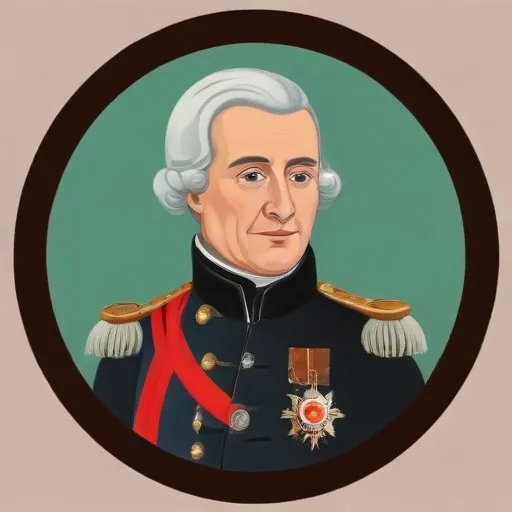
A German nobleman who ruled Brandenburg-Ansbach from 1486 to 1515, known for his military campaigns and territorial expansions. He played a significant role in shaping the region's history.
George of Brandenburg-Ansbach, also known as George the Pious, was a prominent German nobleman and Margrave of Brandenburg-Ansbach from the House of Hohenzollern. He is renowned for his role in introducing the Protestant Reformation in Upper Silesia and Franconia, making him a pioneering figure in the history of Christianity.
Born on March 4, 1484, in Ansbach, George was the second of eight sons of Margrave Frederick the Elder and Sophia of Poland, daughter of Casimir IV of Poland and Elisabeth of Habsburg. This noble lineage granted him connections to the royal courts of Poland, Hungary, and Bohemia.
In 1506, George entered the service of his uncle, King Vladislaus II of Bohemia and Hungary, at his court. The king received him as an adopted son and entrusted him with significant responsibilities, including the Duchy of Oppeln in 1515 and membership in the tutelary government of Hungary in 1516. This marked the beginning of George's rise to power and influence in the region.
Through a series of hereditary treaties and strategic acquisitions, George expanded his territories, gaining control over the duchies of Ratibor and Oppeln, as well as the territories of Oderberg, Beuthen, and Tarnowitz. His most significant achievement was the acquisition of the Duchy of Jgerndorf, which granted him control over all of Upper Silesia.
As the owner and mortgagee of these territories, George paved the way for the introduction of the Protestant Reformation in Upper Silesia and Franconia. He was one of the first German princes to adopt the new faith, preceding even his younger brother Albert, the Grand Master of the Teutonic Order.
George's vision and leadership played a crucial role in shaping the history of Christianity in Europe. His introduction of the Protestant Reformation in Upper Silesia and Franconia paved the way for future reformers and leaders. Today, he is remembered as a pioneering figure, whose contributions continue to inspire and influence generations.
George's leadership and vision set him apart from his contemporaries. While other noblemen were focused on expanding their territories through military conquest, George chose a more strategic and peaceful approach, leveraging his connections and diplomacy to achieve his goals.
George's adoption of the Protestant Reformation reflects his commitment to religious reform and his desire for a more personal and direct connection with God. His leadership and vision continue to inspire and influence those seeking a deeper understanding of Christianity.
Born in 1786
The King of Bavaria who commissioned the iconic Neuschwanstein Castle, a fairytale-like palace that inspired the Disney castle, and was a patron of the arts, supporting Richard Wagner's operas.
