


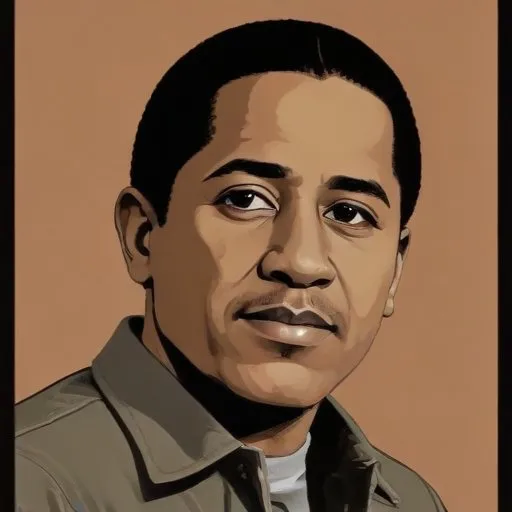
Co-founder of the Black Guerrilla Family, a revolutionary Marxist-Leninist organization, and author of influential prison letters that exposed the harsh realities of the US prison system. His writings sparked widespread outrage and calls for reform.
George Jackson, the American black revolutionary, was known for his unflinching advocacy for prison reform, racial equality, and his role as a powerful voice of the Black Panther Party. His 1970 book, Soledad Brother: The Prison Letters of George Jackson, remains a testament to his unwavering commitment to the cause, shedding light on the brutal realities of the American prison system.
Born on September 23, 1941, in Chicago, Illinois, George Jackson's childhood was marked by poverty, violence, and racism. His experiences would later shape his radical views and inform his writing. Jackson's natural talent for poetry and writing was nurtured by his mother, who encouraged his love for literature.
In 1961, Jackson was sentenced to one year to life in prison for a string of robberies. During his incarceration, he became politicized, immersing himself in the works of Marx, Lenin, and Mao. He joined the Black Panther Party, using his literary skills to craft powerful letters and essays that exposed the inhumane conditions within the prison system.
Published in 1970, Soledad Brother is a collection of Jackson's prison letters, offering a firsthand account of life behind bars. The book became an instant bestseller, earning Jackson international recognition and solidifying his position as a leading voice of the Black Panther Party.
On August 21, 1971, George Jackson was killed in a shootout with prison guards during a failed escape attempt. His death sparked widespread protests and outrage, cementing his status as a martyr for the Black Power movement.
Today, Jackson's legacy extends far beyond his prison cell. His writing continues to inspire social justice movements, and his unyielding commitment to the cause remains a beacon of hope for marginalized communities around the world.
George Jackson's impact on modern society is undeniable. His writings have influenced generations of activists, from Angela Davis to Ta-Nehisi Coates. His calls for prison reform and racial equality continue to resonate, inspiring contemporary movements such as Black Lives Matter and the prison abolition movement.
Jackson's revolutionary zeal and literary prowess invite comparisons with other prominent figures of the Black Power movement, including Huey P. Newton and Eldridge Cleaver. While each contributed uniquely to the struggle, Jackson's prison letters remain a singular testament to the power of the human spirit in the face of oppression.
84 Years Old
Co-founder of the Black Panther Party, a revolutionary socialist organization that advocated for African American empowerment and challenged police brutality in the 1960s and 1970s. Known for his charismatic leadership and radical ideology.
90 Years Old
Co-founder of the Black Panther Party, a radical organization that fought for African American rights and empowerment in the 1960s and 1970s, known for his activism and leadership during a tumultuous period in American history.
91 Years Old
A former Black Panther Party leader and writer, known for his prison memoir "Soul on Ice" and his role in the Black Power movement.
85 Years Old
A prominent figure in the Civil Rights Movement, advocating for Black Power and self-defense, and famously coining the term "Black Power" in 1966. Known for his radical approach to achieving racial equality.
Born in 1925
A prominent figure in the Civil Rights Movement, advocating for African American rights and self-defense, and a powerful orator who inspired a generation.
97 Years Old
A prominent leader in the civil rights movement, advocating for racial equality and social justice through nonviolent means, leaving a lasting impact on American history.
78 Years Old
The chairman of the Illinois chapter of the Black Panther Party, a charismatic leader who advocated for racial equality and social justice through community empowerment and political activism. He's most known for his impassioned speeches and radical approach to fighting systemic racism.
Born in 1926
A prominent leader in the American Civil Rights Movement, he worked closely with Martin Luther King Jr. to advocate for racial equality and social justice through nonviolent means.
