


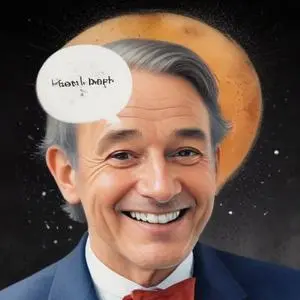
A Dutch physicist and academic who pioneered work on black holes and quantum mechanics, earning a Nobel Prize in Physics in 1999.
Gerard t'Hooft, a Dutch theoretical physicist, is renowned for his groundbreaking work in elucidating the quantum structure of electroweak interactions, earning him the 1999 Nobel Prize in Physics. Alongside his thesis advisor Martinus J. G. Veltman, t'Hooft's research has had a profound impact on our understanding of gauge theory, black holes, quantum gravity, and the fundamental aspects of quantum mechanics.
Born on July 5, 1946, in Den Helder, Netherlands, t'Hooft grew up in The Hague, surrounded by a family of scholars. His great uncle, Frits Zernike, was a Nobel laureate, and his uncle Nico van Kampen was an emeritus professor of theoretical physics at Utrecht University. This rich academic heritage instilled in t'Hooft a passion for science from an early age.
After attending the Dalton Lyceum, t'Hooft excelled in science and mathematics, winning a silver medal in the second Dutch Math Olympiad at the age of 16. He went on to pursue a physics program at Utrecht University, where his uncle taught, and graduated in 1964.
t'Hooft's doctoral research, supervised by Martinus Veltman, focused on the renormalization of gauge theories. His work led to a breakthrough in understanding the quantum structure of electroweak interactions, which was recognized with the 1999 Nobel Prize in Physics.
In addition to his Nobel recognition, t'Hooft's contributions to physics include:
t'Hooft has held various academic positions, including professorships at Utrecht University and Stanford University. He has also been a visiting professor at several institutions, including Harvard University and the University of California, Berkeley.
Some of his notable publications include:
t'Hooft's work has led to a deeper understanding of the nature of space and time. He has also explored the philosophical implications of quantum mechanics, advocating for a deterministic interpretation of the theory.
In his words, "I think that the laws of physics are deterministic, and that the probabilistic nature of quantum mechanics is a consequence of our limited knowledge of the universe."
t'Hooft has received numerous honors and awards, including the Spinoza Prize, the Franklin J. Chuwen Memorial Award, and the Breakthrough Prize in Physics.
In addition to his academic pursuits, t'Hooft is an avid musician and has a passion for playing the piano.
t'Hooft's contributions have had a profound impact on our understanding of the universe, shaping the course of modern physics research. His work continues to inspire new generations of physicists, ensuring his legacy in the annals of scientific history.
In conclusion, Gerard t'Hooft's pioneering work has left an indelible mark on the world of physics, and his contributions will continue to shape our understanding of the universe for generations to come.
84 Years Old
A brilliant mind who unraveled the mysteries of black holes and the universe, making complex physics accessible to all through bestselling books.
95 Years Old
A renowned expert in the fields of physics, mathematics, and philosophy, known for his groundbreaking work on black holes, cosmology, and the nature of consciousness. His theories have reshaped our understanding of the universe and the human mind.
75 Years Old
A renowned theoretical physicist and professor, known for his groundbreaking work on superstring theory and its application to cosmology and particle physics.
54 Years Old
Developed groundbreaking theories on particle physics, particularly on the nature of space and time, and is a leading figure in the quest for a unified theory of physics.
64 Years Old
Theoretical physicist and cosmologist who has made groundbreaking contributions to our understanding of the universe, particularly in the areas of dark matter and extra dimensions.
63 Years Old
Theoretical physicist and mathematician who has written extensively on string theory and its implications for our understanding of the universe, making complex concepts accessible to a broad audience.
68 Years Old
Astrophysicist and science communicator who makes complex concepts accessible to the masses through engaging writing and hosting popular TV shows. He's a leading voice in promoting science education and critical thinking.
